Understanding Matcha Grades: Ceremonial vs Premium vs Culinary
Why Matcha Grading Matters
Maison Genkai sources its premium matcha and hojicha exclusively from Yame, Fukuoka. Current formats, prices and availability are listed in the shop.
In Japan, matcha quality is assessed through long-established production and sensory criteria. The Western labels ceremonial, premium and culinary are commercial categories, not legally standardised Japanese grades. At Maison Genkai, we follow these traditional Japanese criteria, not marketing shortcuts. Understanding the difference between ceremonial, premium, and culinary grades will help you make better purchasing decisions: whether you're a home enthusiast, a café owner, or a pastry chef sourcing ingredients for a Michelin-starred kitchen.
How Grades Are Determined in Japan
Matcha quality assessment is not arbitrary, even though these labels are not official grades. It is the cumulative result of three critical production decisions: when the tea is harvested, how long it is shaded before picking, and how finely it is milled. Each factor has a measurable impact on the final cup.
Harvest timing is the single most important variable. The first spring flush (ichiban-cha, 一番茶), harvested in late April to May, produces leaves with the highest concentration of amino acids, particularly L-theanine, and the lowest bitterness. Later harvests accumulate more catechins and tannins, which translate to astringency. A second-harvest matcha is chemically a different product.
Shading duration directly controls chlorophyll and L-theanine levels. When tea plants are covered, traditionally with bamboo and straw tana structures, or modern kabuse nets: photosynthesis is restricted. The plant compensates by producing more chlorophyll (giving ceremonial matcha its vivid jade colour) and converting theanine precursors at an accelerated rate. Shading for roughly twenty days or more is common for high-end tencha, but there is no legal 21-day minimum for a product to be called ceremonial.
Stone-milling (ishiusu, 石臼) is where most of the cost lives. Granite millstones grind tencha leaves at roughly 30–40 grams per hour. The slow process generates minimal heat, preserving volatile aromatics and producing a talc-fine powder. Ball milling is also used by some producers, including for ceremonial grades, with results depending on calibration and rotation speed. Milling method, speed and calibration can affect heat, particle size and aroma. Matcha remains a suspension rather than a truly soluble powder regardless of the mill. You can feel the difference between stone-milled and machine-ground matcha the moment you touch it, one disappears into the skin, the other sits on top.
Ceremonial Grade (薄茶 Usucha): Full Profile
True ceremonial matcha meets the following criteria across every dimension:
- Harvest: First harvest only (ichiban-cha, 一番茶), the first flush of spring, typically late April to May in Yame, Fukuoka
- Shading: Minimum 21 days under traditional tana or kabuse covers, which boosts L-theanine and chlorophyll to their peak
- Processing: Leaves are steamed (not pan-fired), dried to tencha (碾茶), deveined, destemmed, then slowly stone-milled at ~40 g/hour
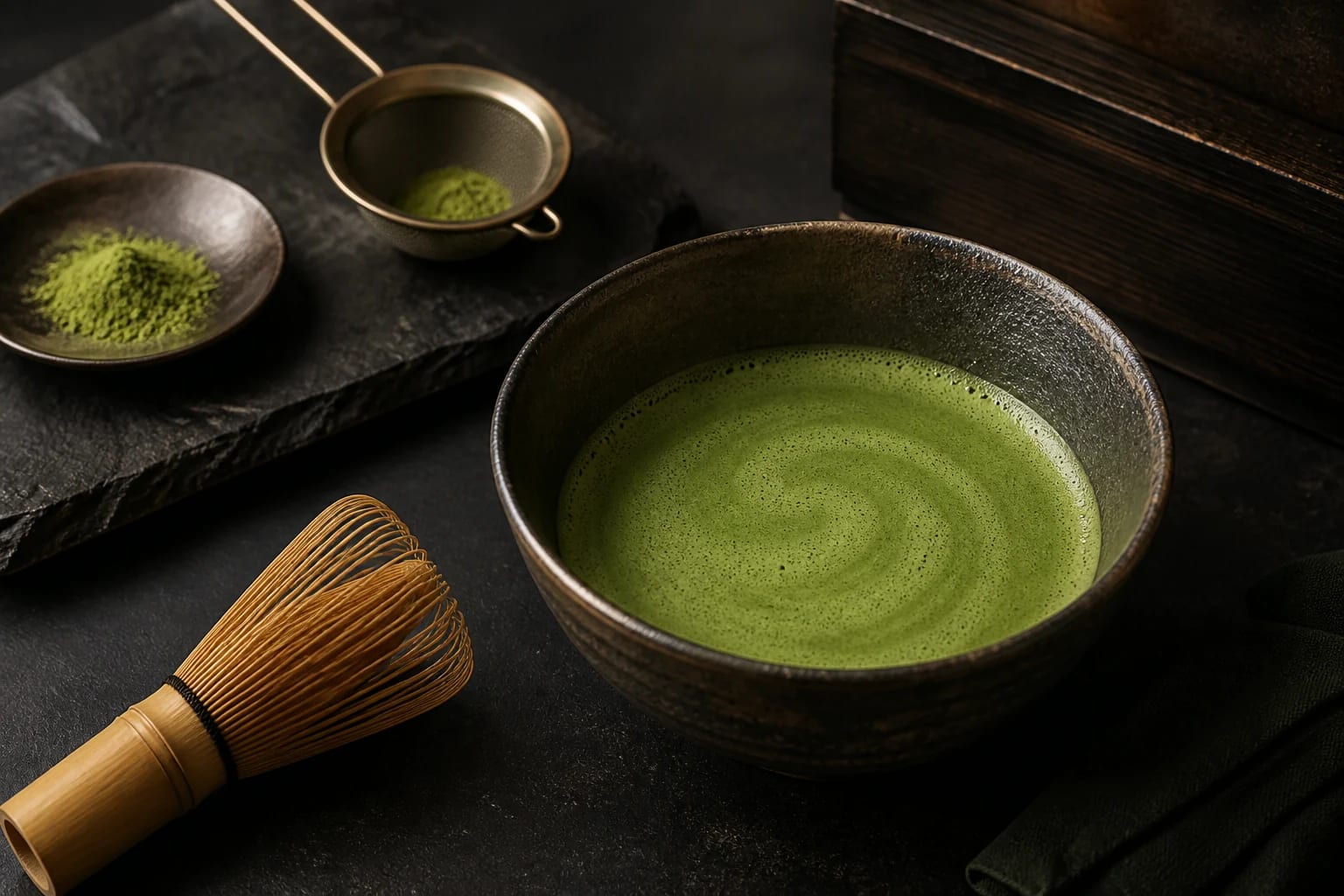
- Colour: Vibrant emerald to jade green: never yellowish or dull. The colour is the most reliable quality indicator visible to the naked eye
- Taste: Pronounced umami, natural sweetness, zero bitterness. Can be prepared as usucha (thin tea) with just water, no sweetener needed
- Texture: Ultra-fine and talc-like: disperses readily in water with minimal grit, but remains a suspension
- Price range: at prices that vary by lot, format and current offer, depending on origin and specific cultivar
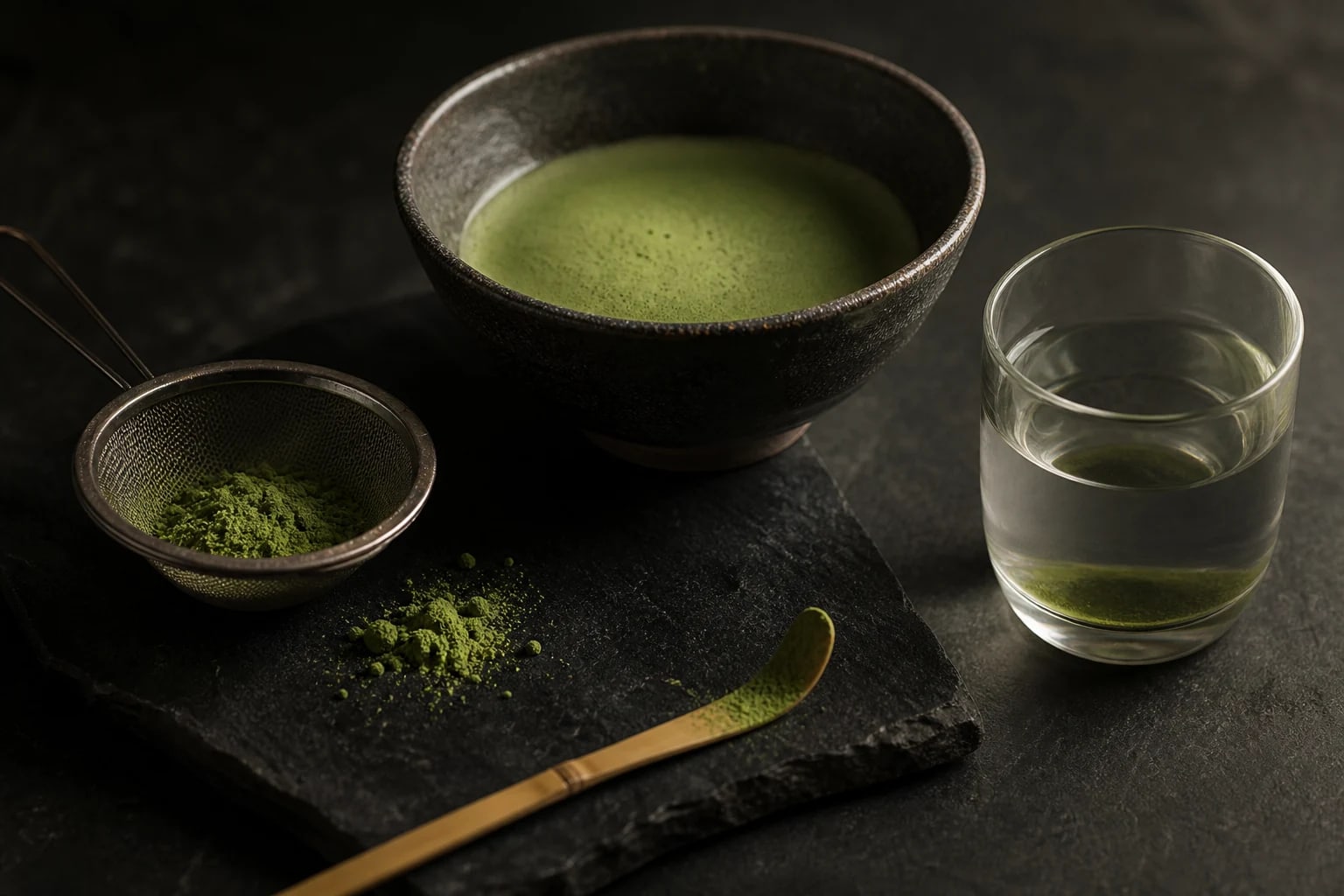
- Best use: Prepared with 70°C water, 2g per 70ml, whisked with a chasen. Drunk as-is, no milk, no sugar
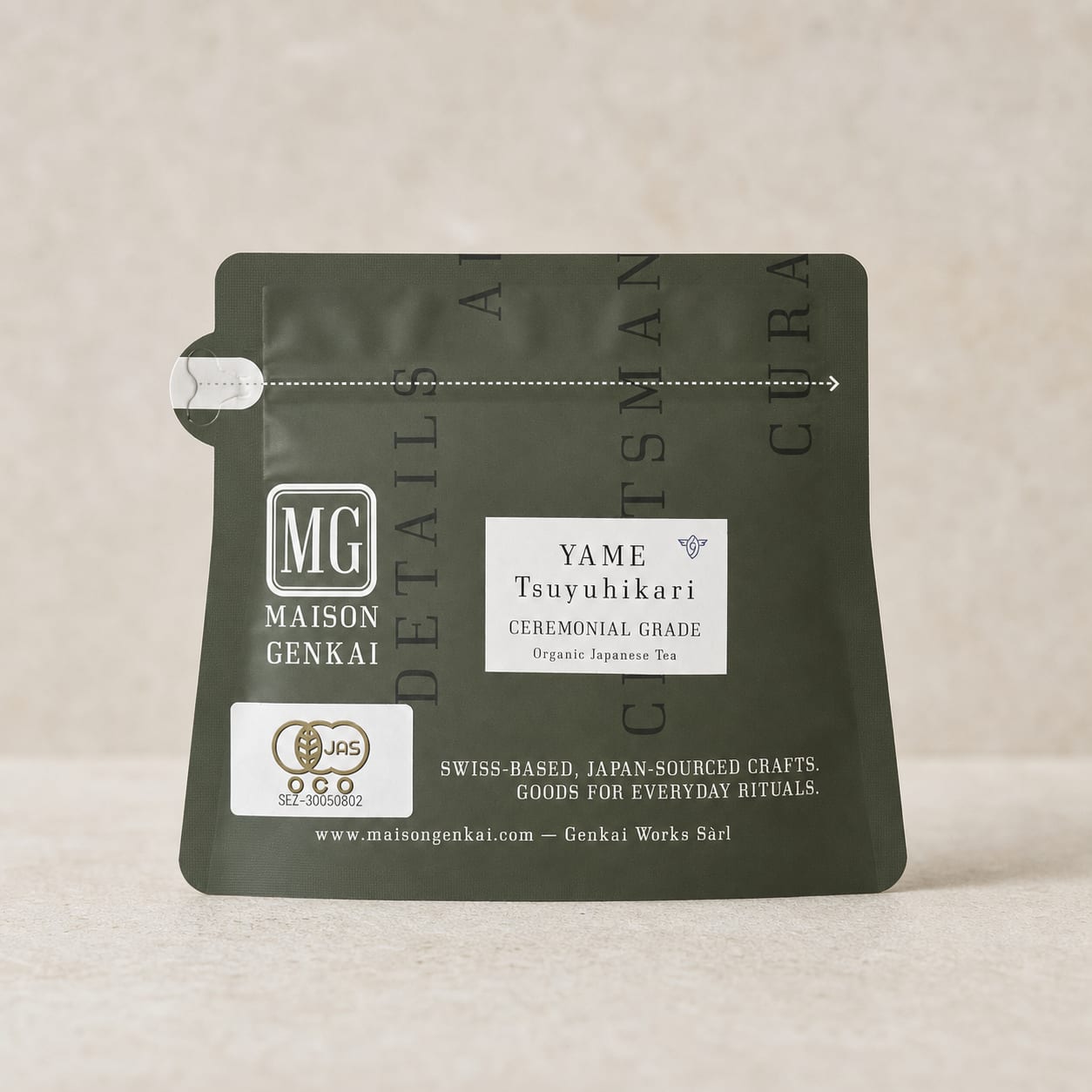
Our premium matcha from Yame meets every criterion above, sourced directly from a single farm in Fukuoka Prefecture.
Premium Grade, Full Profile
Premium matcha occupies the productive middle ground: excellent quality, versatile, and the right choice for most daily drinking and high-end café applications:
- Harvest: First or early second harvest
- Shading: Minimum 14 days
- Processing: Stone-milled or high-quality blade-mill; finely ground
- Colour: Bright green, vibrant but slightly less saturated than ceremonial
- Taste: Rich, layered flavour with slight astringency that integrates well with milk or oat milk
- Texture: Fine, minimal grit
- Price range: at prices that vary by lot, format and current offer
- Best use: Matcha lattes, iced matcha, drinking straight or with a touch of honey
Culinary Grade: Full Profile
Culinary matcha is an ingredient, not a beverage. It is engineered to deliver matcha flavour in the presence of fats, sugars, and heat, conditions that would make subtle ceremonial nuances irrelevant:
- Harvest: Second or later harvest (niban-cha, sangan-cha)
- Shading: Variable, often less than 14 days or none
- Processing: Typically machine-milled; coarser grind acceptable
- Colour: Yellow-green to olive: acceptable because it will be mixed into other ingredients
- Taste: More astringent and bitter, designed to hold its flavour profile when mixed with sugar, butter, cream, or other strong ingredients
- Texture: Coarser: fine enough for baking and cooking applications
- Price range: at prices that vary by lot, format and current offer
- Best use: Matcha tiramisu, cookies, ice cream, smoothies, sauces
Grade Comparison Table
| Criterion | Ceremonial | Premium | Culinary |
|---|---|---|---|
| Harvest | 1st flush (ichiban-cha) | 1st or early 2nd | 2nd or later |
| Shading | 21+ days | 14+ days | <14 days / variable |
| Milling | Granite stone (40 g/h) | Stone or precision blade | Industrial machine |
| Colour | Vivid jade / emerald | Bright green | Yellow-green / olive |
| Taste | Deep umami, sweet, no bitterness | Rich, slight astringency | Bitter, robust |
| Texture | Talc-fine | Fine | Coarser |
| Price | Depends on the lot and current offer | ||
| Best for | Traditional preparation, ceremony | Lattes, daily drinking | Baking, cooking, blending |
Use Case Guide: Which Grade for Which Application
Traditional bowl preparation (chawan): Ceremonial only. The point of preparing matcha in a bowl with nothing but water is to experience the full expression of the leaf, umami, sweetness, umami aftertaste. Using culinary grade in a bowl of water produces an unpleasant, bitter drink.
Matcha latte (hot or iced): Premium grade is the optimal choice. The slight astringency integrates with milk fat, and the price point allows for generous portions. Ceremonial grade used in lattes is technically fine but wasteful: the milk masks the nuances you're paying for.
Pastry, baking, cooking: Culinary grade is specifically designed for this. It holds flavour at elevated temperatures and in fat-rich batters. Using ceremonial grade in a matcha cake is like cooking with a Grand Cru Burgundy, the expense is entirely lost.
Cold brew / mizudashi: Premium or ceremonial. Cold water extraction is gentler and preserves more delicate compounds; using a quality grade here makes a noticeable difference.
Smoothies and protein shakes: Culinary or premium, depending on your palate. The strong flavours in a smoothie benefit from a more assertive matcha.
B2B Buying Guide: Which Grade for Your Venue
For hospitality and food service buyers, the grade decision is a margin and brand positioning decision as much as a flavour one. Here is how we advise our B2B clients at Maison Genkai:
Maison Genkai sources its premium matcha and hojicha exclusively from Yame, Fukuoka. Current formats, prices and availability are listed in the shop.
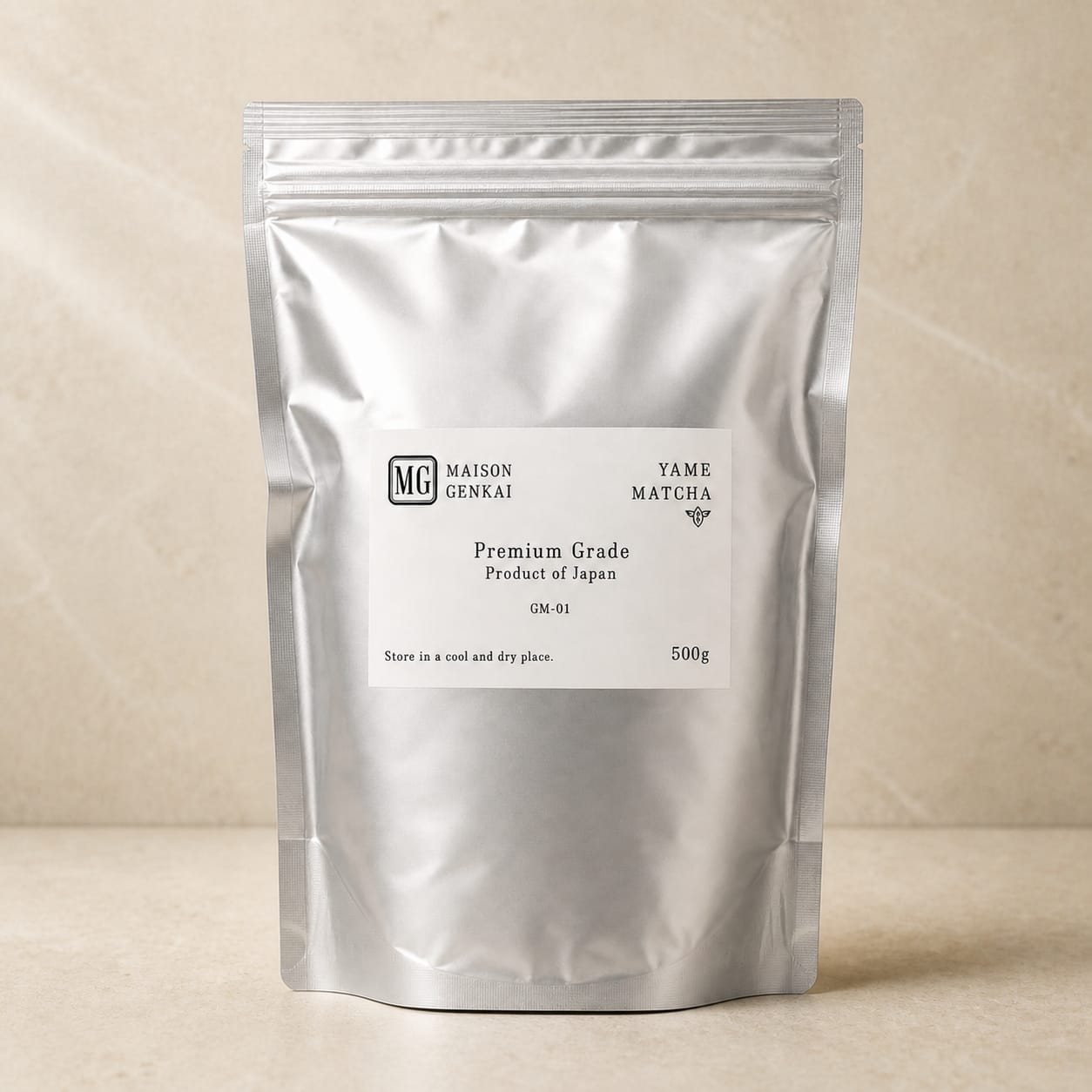
Hotel breakfast buffet or room service: Premium grade is the right answer. Volume and consistency matter more than peak quality in a buffet context. A 500g professional pack of premium grade delivers consistent colour, flavour, and foam at a predictable cost per cup.
Pastry kitchen (restaurant or pâtisserie): Culinary grade for all baking applications. If you are making a matcha-flavoured cream or sauce that will be served uncooked (e.g., a matcha crème anglaise or a finishing powder), premium grade is worth the step-up, the flavour is more refined and the colour more vivid on the plate.
Wellness centre or yoga studio: Premium or ceremonial, depending on your offering. These environments attract customers who are specifically interested in the health and flavour properties of matcha; they will notice the difference and often ask questions about origin. Serve ceremonial if you want to make matcha a genuine differentiator.
For B2B pricing, volume discounts, and sample requests, contact us at youssef@maisongenkai.com.
Common Misconceptions About Matcha Grades
"Ceremonial grade is always better." Not for every application. Ceremonial matcha prepared in a matcha cake loses everything that makes it ceremonial. The grade system is a fit-for-purpose classification, not a universal quality ranking. Use each grade where it performs best.
"Dark green always means better quality." Colour is one indicator, but it can be manipulated. Some producers add food colouring or use UV-blocking covers aggressively to produce colour without the underlying amino acid profile. Colour should be corroborated by taste, origin documentation, and milling method.
"Japanese matcha is always higher quality than Chinese." Origin matters, but within Japan, there is enormous variation. Yame (Fukuoka) and other Japanese regions are the two most prestigious origins, each with distinct flavour profiles. Other regions like other Japanese regions produce large volumes at mid-range quality. A well-produced Chinese matcha can outperform a poorly-produced Japanese one, though top-tier ceremonial grade is exclusively Japanese.
"Organic means better matcha." Organic certification is a farming practice standard, not a flavour or quality standard. Some of the world's best matcha is not certified organic because traditional Japanese farms often use minimal inputs but cannot afford the certification cost. Source transparency matters more than certification labels.
"More foam = better quality." Foam volume is primarily a function of whisking technique and water temperature, not grade. What grade affects is the stability and fineness of the foam, ceremonial grade holds fine bubbles longer due to its protein content.
How to Verify Authenticity
Without regulatory enforcement, buyers must apply their own due diligence. The following signals distinguish genuine ceremonial-grade matcha from mislabelled products:
- Origin documentation: Legitimate producers will specify the prefecture, the farm or cooperative, the cultivar (e.g., Okumidori, Yabukita, Samidori), and the harvest year. Generic "Product of Japan" labelling is a red flag
- Harvest information: The label or product page should state "first harvest" or "ichiban-cha." A ceremonial label on a later-harvest product requires especially clear harvest and sensory disclosure
- Shading duration: 21+ days for ceremonial, 14+ for premium. If not stated, ask. If they can't answer, that tells you everything
- Milling method: "Stone-milled" or "ishiusu-ground" indicates traditional processing. Machine-ground or no information = lower tier
- Sensory test: Prepare 2g in 70ml of 70°C water and taste with no additives. Genuine ceremonial matcha should be sweet, umami-forward, and not bitter. Bitterness prepared this way = lower grade, regardless of the label
- Price reality check: at an unusually low price of "ceremonial grade" is economically implausible given stone-milling costs alone. It is not ceremonial grade
- Our standard at Maison Genkai: We publish full traceability for every product: farm, cultivar, harvest date, shading duration, and milling method. If any producer cannot match this level of transparency, that is your answer
The European Labelling Problem
Many retailers label second-harvest, machine-ground matcha as "ceremonial" to justify premium pricing. Without regulation, consumers have no way to verify claims.
At Maison Genkai, we publish our exact grading criteria and source directly from farms in Yame, Fukuoka. Our premium matcha from Yame meets the standards used by Japanese tea masters, not marketing departments. We also carry a premium hojicha from Yame roasted in the same tradition, for those seeking a caffeine-light alternative with comparable production rigour.
How to Spot Low-Quality "Ceremonial" Matcha
- Dull or yellowish colour (real ceremonial matcha is vivid green)
- Strong bitterness when prepared with just water
- Gritty texture (indicates low-quality milling)
- No information about harvest, origin, or shading duration
- Suspiciously low price (at an unusually low price)
- No farm or cultivar information: only "Product of Japan"
- Unable to answer direct questions about processing method
Read next
To go further, see How to Choose Matcha: 2026 Buying Guide, then What Is Ceremonial Matcha? Complete Guide. For a complementary angle, also read Which Matcha Should You Choose for a Matcha Latte?.
For cafés, restaurants and retailers
Looking for a Swiss matcha supplier?
Maison Genkai supplies Japanese matcha from Yame to professionals in Switzerland, with samples, volume pricing, and formats for service or resale.