Japan’s Five Great Tea Regions
To say a tea comes from Japan is not enough to truly understand it. Between the open plateaus of Shizuoka, the southern lands of Kagoshima, the foothills of Mie, the misty valleys of Yame, and the historic gardens associated with Uji, the leaf encounters very different climates, cultivars, and gestures. These five Japanese tea regions thus provide a useful vocabulary for speaking of freshness, umami, astringency, texture, and aroma.
One common shortcut must nevertheless be avoided: an origin is neither a grade nor an automatic promise of quality. The region tells us where a tea belongs; the lot itself also depends on cultivar, harvest, shading, steaming, rolling or its absence, sorting, milling and freshness. This guide compares five major terroirs without ranking them or confusing collective reputation with the quality of a specific product.
Why origin is not a grade
Terroir has a genuine effect on Japanese tea. Altitude, slope, drainage, rainfall, mist, wind and the temperature difference between day and night alter the pace of growth. Yet these natural factors come at the beginning of a long chain. The same garden can yield different results depending on harvest date, shoot vigour and processing choices.
The type of tea matters just as much. Sencha is steamed, rolled and then dried. Fukamushi-sencha receives a longer steaming, which breaks down the leaf further and often produces a denser liquor. Kabusecha is shaded for a relatively short period before harvest. Gyokuro is shaded for longer, then rolled. Tencha, the raw material for matcha, is shaded, steamed and dried without rolling; once stems and veins are removed, it can be milled. Exact durations vary by producer and growing conditions.
Finally, a cultivar is not a fixed flavour. Yabukita, Saemidori and Okumidori indicate tendencies, not guaranteed results. To read a product description critically, our guide to matcha origin and quality provides the necessary context beyond the region’s name.
Comparative table of the five regions
| Region | Detailed comparison |
|---|---|
| Shizuoka | Terroir and climate: plains, plateaux such as Makinohara and cooler mountain valleys; a wide range of exposures. Cultivars: Yabukita, Tsuyuhikari and other selections depending on the area. Methods and specialties: sencha, fukamushi-sencha and Asahina gyokuro; steaming adjusted to the intended style. Taste: clean vegetal notes, freshness and balance between sweetness and astringency; more body in fukamushi. |
| Kagoshima | Terroir and climate: warm southern climate, basins with often volcanic soils and a long harvest window. Cultivars: Yutakamidori, Saemidori, Asatsuyu, Okumidori and Yabukita. Methods and specialties: early hashiri-shincha, sencha, fukamushi and growing tencha production. Taste: vivid colour, roundness, sweetness and fruit depending on the cultivar; generous texture with deep steaming. |
| Mie / Ise-cha | Terroir and climate: from the foothills of the Suzuka mountains to areas near Odaigahara; contrasts between north and south. Cultivars: Yabukita remains important, alongside local diversity between gardens. Methods and specialties: kabusecha in Hokusei, fukamushi-sencha in Nansei and sencha. Taste: elegant shaded aroma and roundness in kabusecha; body and aromatic intensity in fukamushi. |
| Yame, Fukuoka | Terroir and climate: mountain-enclosed landscapes, temperature differences and morning mists in inland sectors. Cultivars: Yabukita, Saemidori, Okumidori and Kanayamidori, among others. Methods and specialties: sencha, gyokuro, tencha and matcha; traditional hon-gyokuro under natural covering. Taste: deep umami, roundness, length and shaded aroma; a brighter expression in sencha. |
| Uji, Kyoto | Terroir and climate: slopes, fertile well-drained soils, rainfall and temperature variation in southern Kyoto and associated areas. Cultivars: Samidori, Asahi, Ujihikari, Gokou and Ujimidori. Methods and specialties: tencha and matcha, gyokuro, sencha and kabusecha; a major heritage of shaded cultivation. Taste: precise umami, sweetness, fine texture and shaded aroma; the profile varies with the leaves’ actual origin and finishing. |
Shizuoka: a mosaic rather than a unique style
Shizuoka is understood at the scale of its numerous basins. The large mechanisable plateaus do not tell the same story as the mountain gardens, where the cooler nights and slopes slow the growth. This amplitude explains the variety of sencha produced in the prefecture: some seek a clear and aromatic line, others a greener and more ample liquor thanks to deep steaming.
Yabukita holds a historic place here. This cultivar, later adopted across the country, often provides a clear balance of aroma, sweetness and astringency. Shizuoka also selected Tsuyuhikari, valued for its vivid colour, fresh aroma, density and low astringency. These are reference points, not rules: exposure, harvest and processing remain decisive.
Asahina reveals another side of the prefecture. This cooler mountain valley is one of Japan’s traditional gyokuro centres. Shizuoka is therefore not merely a source of high-volume sencha: it brings together large-scale production, mountain micro-terroirs and shaded teas.
Kagoshima: heat, varietal diversity, and technical precision
At the southern end of Kyushu, Kagoshima benefits from an early start to the growing season. Its warm climate, basins with volcanic soils and range of early- to late-budding cultivars extend the harvest window. Hashiri-shincha, among Japan’s earliest new teas each year, symbolises this head start.
Varietal diversity is a structuring force. Yutakamidori, Saemidori, Asatsuyu, Okumidori, and Yabukita do not ripen at the same time and do not express the same balance between colour, umami, aroma, and astringency. This succession facilitates an organised harvest and makes possible regular blends and lots by cultivar.
Kagoshima uses several degrees of steaming. Fukamushi can produce an opaque, intense and enveloping liquor, while shorter steaming preserves more of the leaf’s shape and some higher aromatic notes. The region also produces tencha. This combination of industrial capacity and craft practice makes it impossible to reduce Kagoshima to a single taste.
Mie: the discreet identity of Ise-cha
Any tea produced in Mie Prefecture can be presented as Ise-cha, but the term encompasses different landscapes. In the north, Hokusei, near the Suzuka mountains, is particularly associated with kabusecha. The bushes are covered before harvest for a shorter period than classic gyokuro. Reduced light preserves more amino acids and encourages rounded sweetness, a deep green colour and the characteristic aroma of shaded tea.
Further south, Nansei is associated with fukamushi-sencha. Longer steaming breaks down the leaf structure further: water reaches the fine particles quickly, giving the infusion more body, colour and intensity. Between these two poles, Mie shows how a prefecture can build its identity on technical choices as much as on terrain.
It is necessary here to correct a common confusion: Hokusei and Nansei are geographical zones, not cultivars. Yabukita remains an important cultivar in Mie, without being the only possible one.
Yame: mist, shading, and depth
In southern Fukuoka Prefecture, Yame combines plains with inland areas enclosed by higher ground. Day–night temperature differences and morning mist are regularly cited as factors behind slower growth and the retention of umami-related compounds. Again, there is no single Yame taste: hillside sencha and heavily shaded gyokuro are two different expressions.
The most tightly defined reference is Yame Dentou Hongyokuro, registered as a geographical indication in Japan. Its traditional method notably combines covering with natural materials such as straw, allowing bushes to grow in their natural form and hand-picking. This knowledge has been passed down for more than 110 years. The aim is a full, mellow liquor rich in umami, with the shading aroma known as ooika.
Yabukita, Saemidori, Okumidori, and Kanayamidori figure among the cultivars that can be encountered in the region, without this list being exhaustive. They must not be attributed to a specific product without lot traceability.
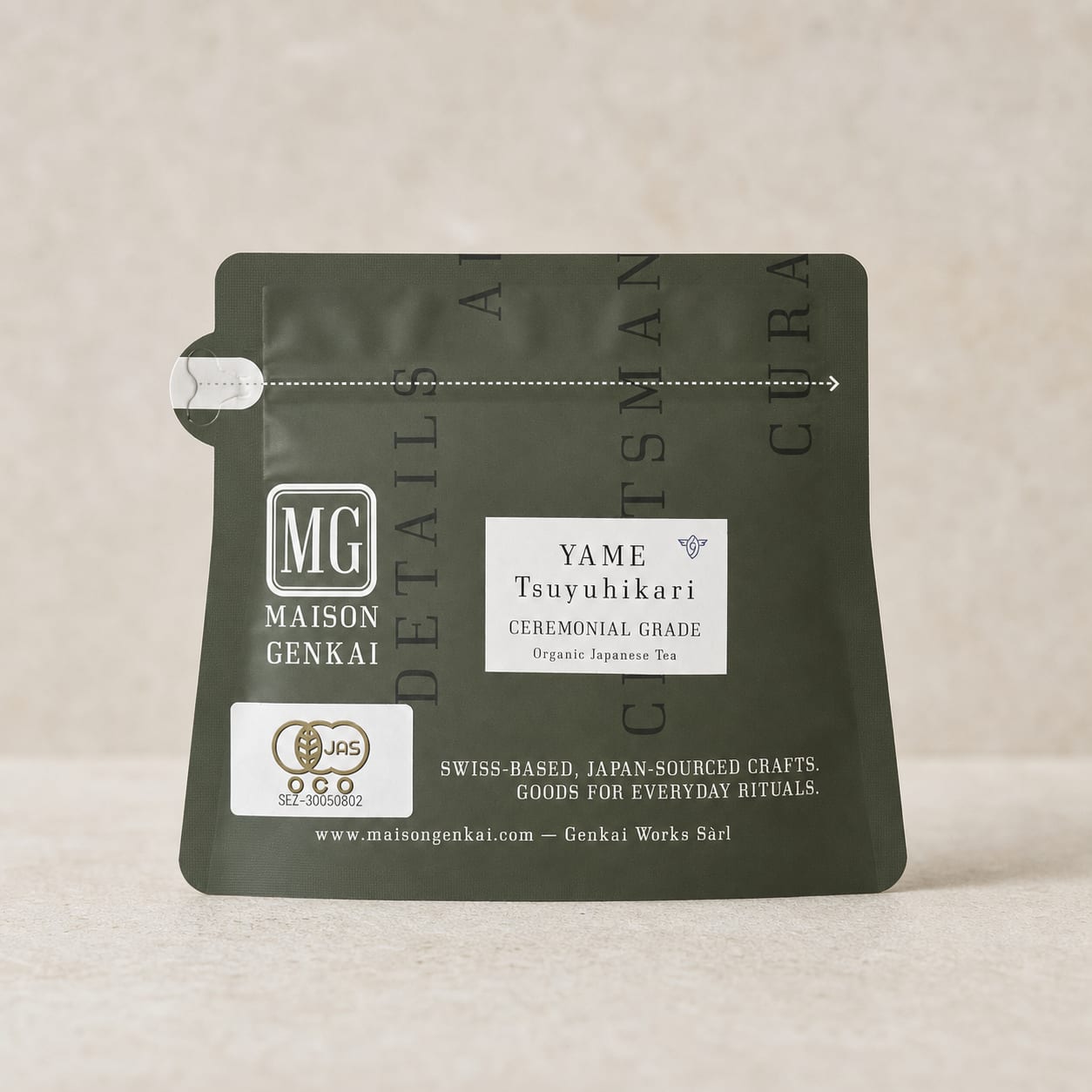
Maison Genkai sources its teas exclusively from Yame, in Fukuoka prefecture. The other four regions of this article are presented solely for comparison of cultures and better reading of Japanese tea; they do not form part of our supply.
Uji: a historical origin to define precisely
Uji occupies a central place in the history of shaded teas and matcha culture. In southern Kyoto, slopes, draining soils, rainfall, and temperature variations have favoured the development of tencha and gyokuro. Cultivars like Samidori, Asahi, and Ujihikari are sought for tencha; Gokou or Ujimidori are also associated with Kyoto's shaded teas. They can offer finesse, colour, sweetness, and a very articulated umami.
The term Uji-cha nevertheless requires one essential clarification. According to the definition reported by Japan’s Ministry of Agriculture, it can designate tea finished in Kyoto using methods originating in Uji and leaves grown in four prefectures: Kyoto, Nara, Shiga and Mie. “Uji-cha” therefore does not automatically mean “leaves grown in Uji city”. To assess a lot, one must distinguish the place of cultivation, place of finishing and production style.
This nuance takes nothing away from Uji's heritage. It allows, on the contrary, to describe it correctly: a major technical and commercial tradition, based on shading, selection, and finishing, rather than a simple municipal border.
How to read an origin without shortcuts
A good product description should answer several questions. Where were the leaves grown? What is the cultivar or blend? Is it a first harvest? How long were the bushes shaded, and with which system? Were the leaves lightly or deeply steamed? For matcha, where was the tencha sorted and milled? Finally, how was the product protected from oxygen, heat and light?
These information allow linking the origin to a probable sensation without transforming it into a verdict. To go further, our matcha grades comparison explains why the words « ceremonial », « premium », and « culinary » remain commercial categories. The guide on traditional and modern matcha preparation also shows how much water, temperature, and dosage modify the perception of the same lot.
Which terroir to choose according to taste?
For a lively and structured cup, a Shizuoka sencha is a good ground for exploration. If one seeks a deep colour, ample texture, and cultivar options, Kagoshima offers a particularly wide spectrum. Those who like a balance between sencha freshness and shaded sweetness can orient themselves towards a Mie kabusecha. Yame and Uji are two major references for shaded tea umami, but their styles are not interchangeable and must be compared lot by lot.
The best choice remains that which unites transparency and adequacy to the use. A delicate tea intended to be drunk pure does not respond to the same brief as a matcha for latte. Our Japanese tea selection indicates the recommended use of each product.
The position of Maison Genkai
Maison Genkai sources exclusively from Yame, Fukuoka. We source no tea from Shizuoka, Kagoshima, Mie, or Uji. Their presence in this guide is strictly comparative and cultural: understanding these regions helps to ask better questions about a tea, not to artificially expand our supply story.
This single-origin focus allows us to build a coherent relationship with the terroir we know and to present products for what they are. It does not mean that Yame is “better” in every circumstance; it means Maison Genkai has chosen the depth and traceability of a precise regional anchor.
Institutional sources
- MAFF — definition of the main Japanese green teas
- Shizuoka Prefecture — tea industry and statistics
- Shizuoka Prefecture — Tsuyuhikari cultivar of Omaezaki
- MAFF — Kagoshima Tea
- Mie Prefecture — Ise-cha, kabusecha, and fukamushi
- MAFF — GI Traditional Authentic Yame Gyokuro
- MAFF — Uji Tea and definition of Uji-cha
- Kyoto Prefecture — historical Uji cultivars
For cafés, restaurants and retailers
Looking for a Swiss matcha supplier?
Maison Genkai supplies Japanese matcha from Yame to professionals in Switzerland, with samples, volume pricing, and formats for service or resale.