Matcha in Switzerland: Why Prices Vary So Much
A budget matcha on a broad marketplace and a smaller premium tin from a focused tea house can look absurdly far apart on price. But those differences are not just empty marketing. Matcha pricing in Switzerland varies because the word “matcha” covers different use cases, different leaf qualities, different harvest logics and very different service models.
The real problem is that the market often compares unlike with unlike. A low-cost ingredient powder gets judged against a premium lot built for pure tasting. This guide helps make the Swiss price landscape easier to read.
Contents
- Use case is the first price variable
- Harvest logic changes the leaf before it changes the price
- Mass-market channels and curated channels do not price the same way
- Format, logistics and service also shape price
- Why the cheapest option can become expensive
- How to read price intelligently in 2026
Use case is the first price variable
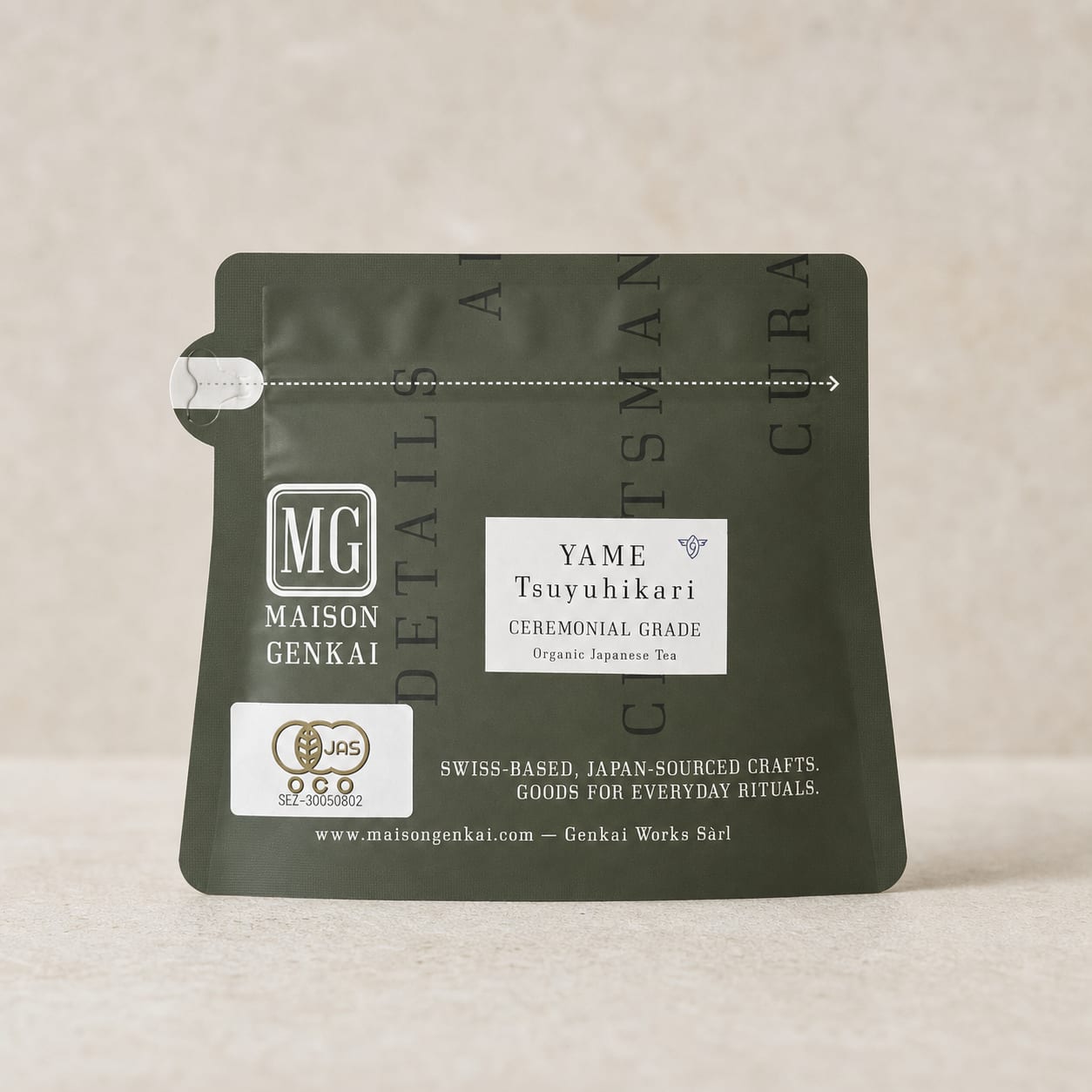
Maison Genkai sources its premium matcha and hojicha exclusively from Yame, Fukuoka. Current formats, prices and availability are listed in the shop.
- Pure bowls and lattes justify different price structures
- Comparing different uses creates false conclusions
- The right price is always relative to the intended cup
Harvest logic changes the leaf before it changes the price
Harvest timing matters. Younger, softer, more carefully shaded leaves, often linked to first-flush or ichibancha logic, are more expensive to grow and select and often yield sweeter, more layered premium profiles. Nibancha and sanbancha can still be excellent, but they often support sturdier everyday or culinary profiles. The Swiss market does not always explain this clearly, even though it is one of the most honest reasons why price bands exist.
- Ichibancha often supports higher-end premium profiles
- Nibancha and sanbancha often support stronger everyday use
- Harvest is a real economic variable, not a poetic detail
Mass-market channels and curated channels do not price the same way
In Switzerland, matcha is now visible across very different retail channels. Broad platforms such as Galaxus already list a wide spectrum of powders, accessories and price points. Retail groups such as Coop and Migros also make the category visible to mainstream shoppers, often through more accessible formats. That broad visibility matters, but it can blur the line between convenience matcha and origin-led premium matcha. The broader the channel, the more price tends to dominate the comparison. The more curated the range, the more value shifts toward clarity of use, sourcing and consistency.
- Galaxus, Coop and Migros show that matcha has entered the Swiss mass market
- Mass visibility does not automatically equal cup refinement
- Curated ranges often charge for clarity and selection, not just for powder
Format, logistics and service also shape price
Matcha is sensitive to freshness, storage and stock rotation. In Switzerland that carries a real cost. Small premium formats, good storage, responsive service and educational content all add value and all add expense. A higher-end tea is often more expensive not only because of the leaf, but because of the way the brand manages the product all the way to the customer’s bowl.
- Swiss logistics create real cost layers
- Smaller premium formats are more expensive to manage
- Service and education are part of the final value
Why the cheapest option can become expensive
- A poor tea becomes expensive if it is not used
- Real cost includes pleasure and repeatability, and the best buy is the one that matches the ritual
How to read price intelligently in 2026
Before comparing prices, ask four questions. What is the intended use? What harvest or selection logic is implied? Is the format coherent? Does the tea house explain its range clearly? If the answer is no, the price alone tells you very little. That is where our internal resources become useful: the buying guide, Matcha FAQ and grade guide give you a proper frame for reading Swiss offers more intelligently.
- Price per gram plus use case is the basic filter
- Harvest and sourcing are structural signals, and the best matcha is not the cheapest or the most expensive, but the most coherent
Three very practical buying scenarios
If you mainly prepare daily lattes, your price reading should stay pragmatic: look for a stable tea that is coherent, repeatable and pleasant enough to use often. If you want pure bowls for quieter moments, you can accept a higher price per gram because you are buying something different from a volume product. And if you are still exploring, the smartest investment is not always the highest grade but the tea that teaches you fastest what you actually like. That distinction between daily use, tasting and learning explains a large part of the Swiss price spread.
Frequently asked questions
Why does matcha cost so differently in Switzerland?
Because it covers different uses, different leaf qualities, different harvest logics and different retail models.
Does a higher price guarantee better quality?
No. It may signal stricter selection, but you still need to read use case, harvest logic, freshness and range coherence.
Why mention Galaxus, Coop and Migros?
Because they show that matcha is now visible in the Swiss mass market, which helps explain the difference between convenience matcha and origin-led premium matcha.
How do I avoid overpaying?
Define your use first, then compare harvest logic, format and real cup intention. Our buying guide is designed to help with exactly that.
Conclusion
Matcha pricing in Switzerland varies because the market collapses several different worlds into one word. Once you compare use, harvest, format, channel and service level, the price bands become easier to understand. The smartest move is not to chase the lowest price, but the best fit for your cup.
Read next
For cafés, restaurants and retailers
Japanese tea for your business
Serving matcha or hojicha, or stocking it in your shop? Tell us how you plan to use it and your expected volumes. We can discuss samples, pack sizes and a quote for your business.
Yame matcha delivered in Switzerland
Find a matcha for your daily ritual
For a morning latte or a bowl of tea, explore our matcha from Yame. Each product page shows the pack size, price and current availability.
Shop matcha