How to Store Matcha After Opening
Matcha does not go bad overnight after opening. It gradually loses what justifies its price: aroma, bright colour, umami and finesse. The powder is particularly sensitive because the entire leaf has been ground into very fine particles, which increases the surface area exposed to air, light, heat and humidity.
The correct method isn't just "put it in the fridge." Cold can slow down some damage, but cold powder opened in a damp room risks condensation. The effective protocol combines airtight packaging, little air, darkness, a stable temperature and allowing the sealed pack to reach room temperature before opening.
The four enemies of matcha
Oxygen
Each time it is opened, the air renews the oxygen present around the powder. Oxidation gradually modifies pigments and aromatic compounds. The matcha appears less luminous, its nose becomes more discreet and its finish may seem flatter or more bitter. Closing quickly is therefore more useful than leaving the container open throughout the preparation.
The light
Light accelerates the degradation of sensitive compounds, including the pigments responsible for color. A study published in 2026 in Food Chemistry measured the combined effect of water activity and light exposure on the stability of matcha. The practical message is clear: opaque packaging protects better than a transparent jar, even if the latter is aesthetically pleasing.
The heat
A study on the storage of matcha at different temperatures observed a decrease in green color and several compounds over time, more marked at elevated temperature. Previous Japanese research also found better sensory preservation at low temperatures than at 37°C. So keep the powder away from the oven, a sunny window and the espresso machine.
Humidity
Dry powder absorbs moisture easily. It then forms aggregates and loses its fluidity; high humidity also increases the risk of deterioration. The spoon must always be dry. In the refrigerator, humidity does not only come from the appliance: it can condense directly from the ambient air on a package that is still cold.
The recommended method after opening
- Keep the original packaging if it is opaque, resealable and in good condition.
- Gently expel excess air from a sachet without unnecessarily compressing the powder.
- Close immediately after taking the dose with a clean, dry spoon.
- Place the sachet in a second airtight container if you refrigerate it, especially near odorous foods.
- Let the closed package come to room temperature before opening it.
- Open only one small format at a time and finish it during its best aromatic window.
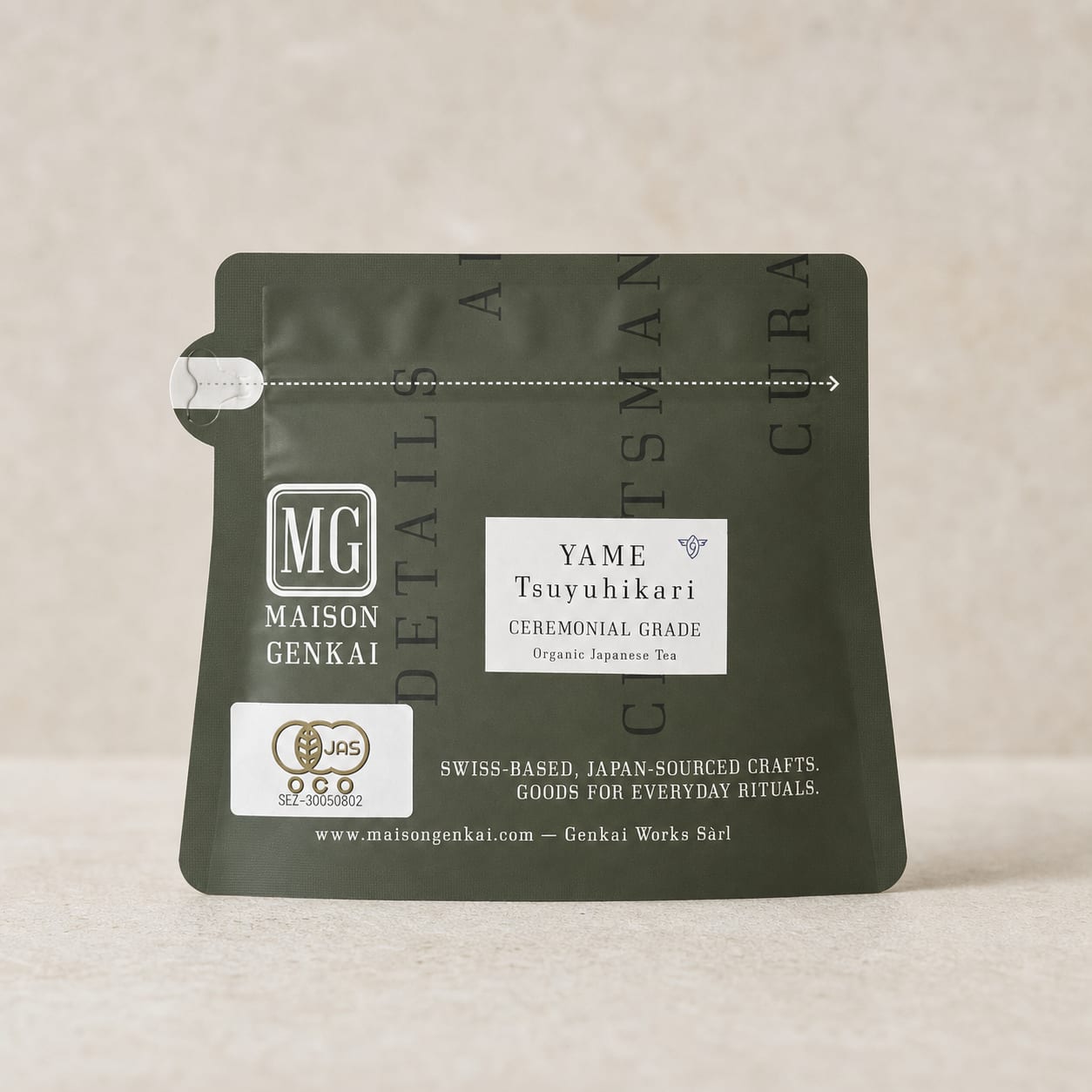
Organic bags Yabukita And Tsuyuhikari from Maison Genkai explicitly indicate refrigerated storage and tightly closed after opening. Always follow the product instruction when it is more specific than generic advice.
Fridge or cupboard?
Both answers can be valid depending on the context. A cool, dark, dry cupboard is suitable for a small sachet consumed quickly, particularly if the kitchen remains temperate. The refrigerator becomes interesting when the room is warm, the rotation is slower or the label requires it. The determining point is the control of condensation and odors.
If you choose the cupboard, place the matcha away from the stove, dishwasher and a window. An “ambient” temperature of 18°C in a Swiss home in winter has nothing to do with a kitchen at 29°C in summer. Advice should therefore take into account the season and the actual room.
If you choose the refrigerator, use an area where the temperature varies little, not the door. Seal the sachet in a separate airtight box or bag. Take out only the necessary quantity, but do not open the cold powder: let the closed container cool so that humidity from the air does not settle inside.
How long does matcha stay fresh?
Safety and quality must be distinguished. The best-before date concerns a sealed product stored under the conditions provided by the manufacturer. After opening, the rate of aromatic loss depends on the packaging, the temperature, the number of openings and the humidity. A universal day-by-day timeline would be misleading.
For the best sensory expression, many teahouses recommend finishing an open matcha in four to eight weeks. This mark is reasonable for a small format, but it is not an expiration date. Older powder may still be consumable if it has been stored correctly and shows no abnormal signs; it will simply often be less vibrant.
At 2g per bowl, a 40g sachet yields around twenty preparations and a 50g format around twenty-five. At five bowls per week, they are finished in four and five weeks respectively: the format naturally fits into the freshness window. This is a practical reason not to open multiple references at the same time.
Can you freeze matcha?
Freezing may be suitable for stock unopened and perfectly airtight, especially for storing several bags over a long period. It becomes more delicate for a container used every day: cold-hot cycles and openings increase the risk of condensation.
If freezing, split before storing rather than bringing out the same large package. Place each sealed portion in waterproof secondary protection. When using, allow the closed package to reach room temperature before breaking the seal. Do not refreeze an opened portion repeatedly.
Should the powder be transferred to another container?
Not necessarily. A good multi-layer, opaque and resealable sachet often provides an excellent barrier. Transferring exposes all the powder to air and can introduce moisture. If you like to use a box, place the closed bag inside rather than systematically pouring out its contents.
A box becomes useful when the packaging no longer closes or allows light to pass through. Choose it small, opaque, clean, dry and odorless. The lower the volume of air above the matcha, the better. Avoid scented wooden boxes and containers that retain the scent of another tea or spice.
Recognizing a matcha that has lost its freshness
Compare several indices rather than just one:
- the color changes from a bright green to a duller or olive green;
- the fresh scent becomes weak, dusty or reminiscent of dry hay;
- the cup appears flatter and the bitterness stands out more;
- the foam may be less stable, even if the technique also plays a role;
- hard lumps appear after exposure to humidity.
A less bright color is not proof of danger. On the other hand, a musty smell, visible humidity, contamination or a frankly abnormal taste mean that you should not consume it. Don’t try to hide a health defect in a latte or pastry.
The most common errors
Open the bag as soon as it comes out of the refrigerator
This is the classic error. Hot, humid air meets cold powder; water may condense. Wait with the container closed. Depending on the size and temperature, fifteen to thirty minutes is often enough for a small sachet, but rely on the feel of the packet rather than an absolute timer.
Leave the powder on the work surface
First prepare the bowl, whisk and water. Then take out the matcha, measure, close and store before whisking. The packet gains nothing by remaining open while the water heats or the milk froths.
Use a wet spoon
A single wet spoon can introduce enough water to create localized clumps. Use a perfectly dry chashaku or spoon. Do not hold the sachet over a steaming kettle.
Buy too big
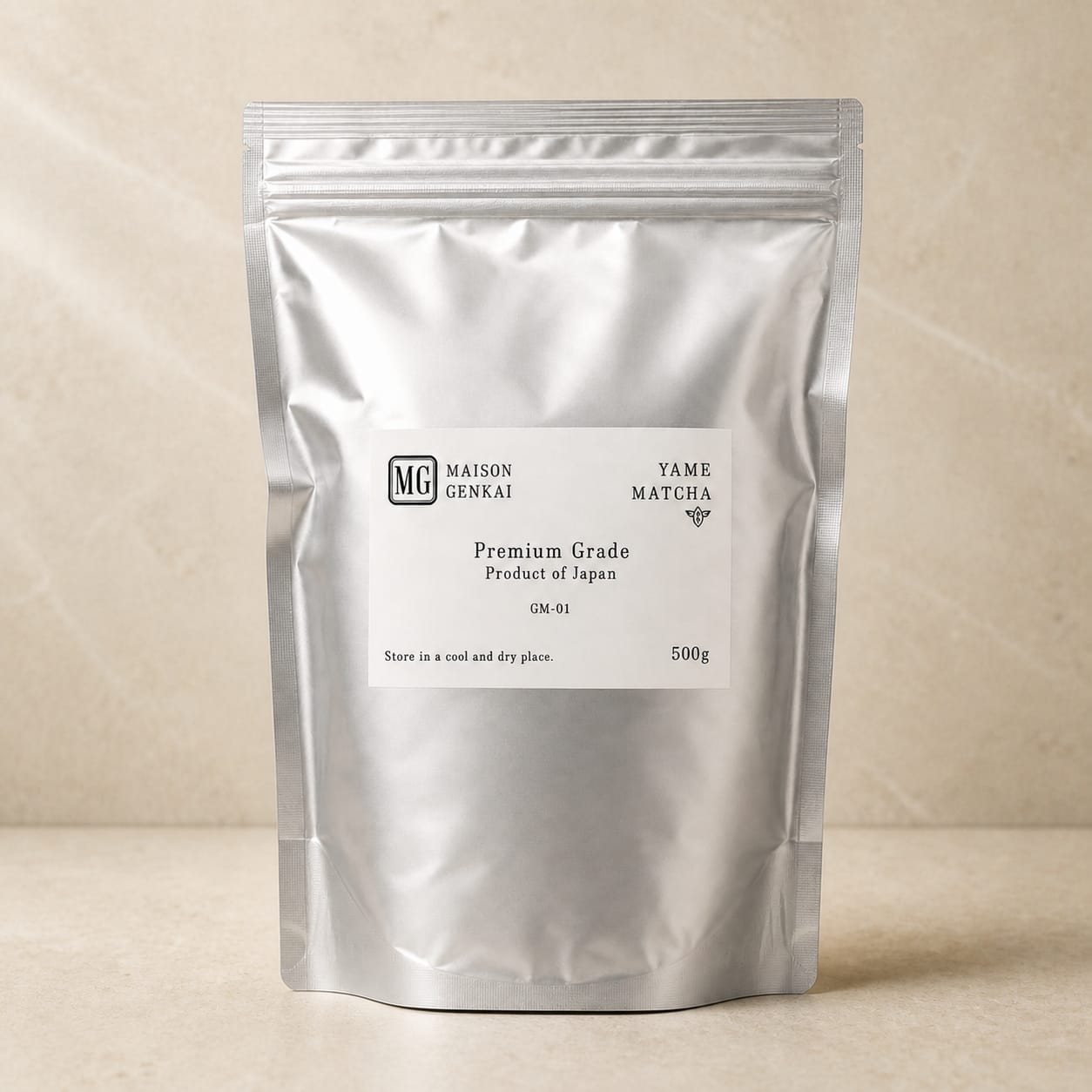
The price per gram sometimes decreases with the format, but the savings disappear if half of the product loses its aromatic interest. For domestic use, the 40 to 50 g formats in the Japanese tea collection are sized for realistic rotation. The 500 g formats are intended for professionals or volume recipes.
Preservation routine in 30 seconds
Take 2 g with a dry tool, expel excess air, close the zip, return the sachet to its secondary container and store it. If the bag was cold, do this whole operation only after letting it cool closed. This simple discipline protects the cup more than an expensive accessory used inconsistently.
To obtain the best result, combine this conservation with controlled preparation: non-boiling water, regular dosing and sieving if necessary. The guide how to prepare matcha covers traditional and modern methods.
Frequently asked questions
Can I keep matcha in its original box?
Yes, if it closes well and protects from light. For a sachet, a secondary box also limits odors and humidity variations. There is no need to pour the powder out of effective barrier packaging.
Is lumpy matcha expired?
Not automatically. Fine particles aggregate naturally and can be separated by sieving. Hard lumps accompanied by humidity, abnormal odor or suspicious traces are, however, a warning signal.
Why does my new matcha seem dull?
Color also depends on cultivar, shading, harvesting, crushing and lighting. Compare the product to its own reference, not to a saturated photo. If the package is recent, intact and well preserved, a less fluorescent shade does not necessarily imply a defect.
Should I refrigerate my matcha every day?
Follow the label first. In a cool kitchen with a small bag finished quickly, a dark cupboard may be adequate. In hot periods or when the manufacturer requests it, the refrigerator is preferable provided it prevents condensation and odors.
In short: keep matcha closed, opaque, dry, fresh and away from odors. In the refrigerator, always allow the closed container to cool before opening. Buy a size you can finish in a few weeks: the best storage starts with realistic rotation.
Read next
To go further, see How to Prepare Matcha: Traditional and Modern Methods, then Matcha Does Not Dissolve: Clumps and Sediment Explained. For a complementary angle, also read How to Choose Matcha: 2026 Buying Guide.