Matcha Does Not Dissolve: Clumps and Sediment Explained
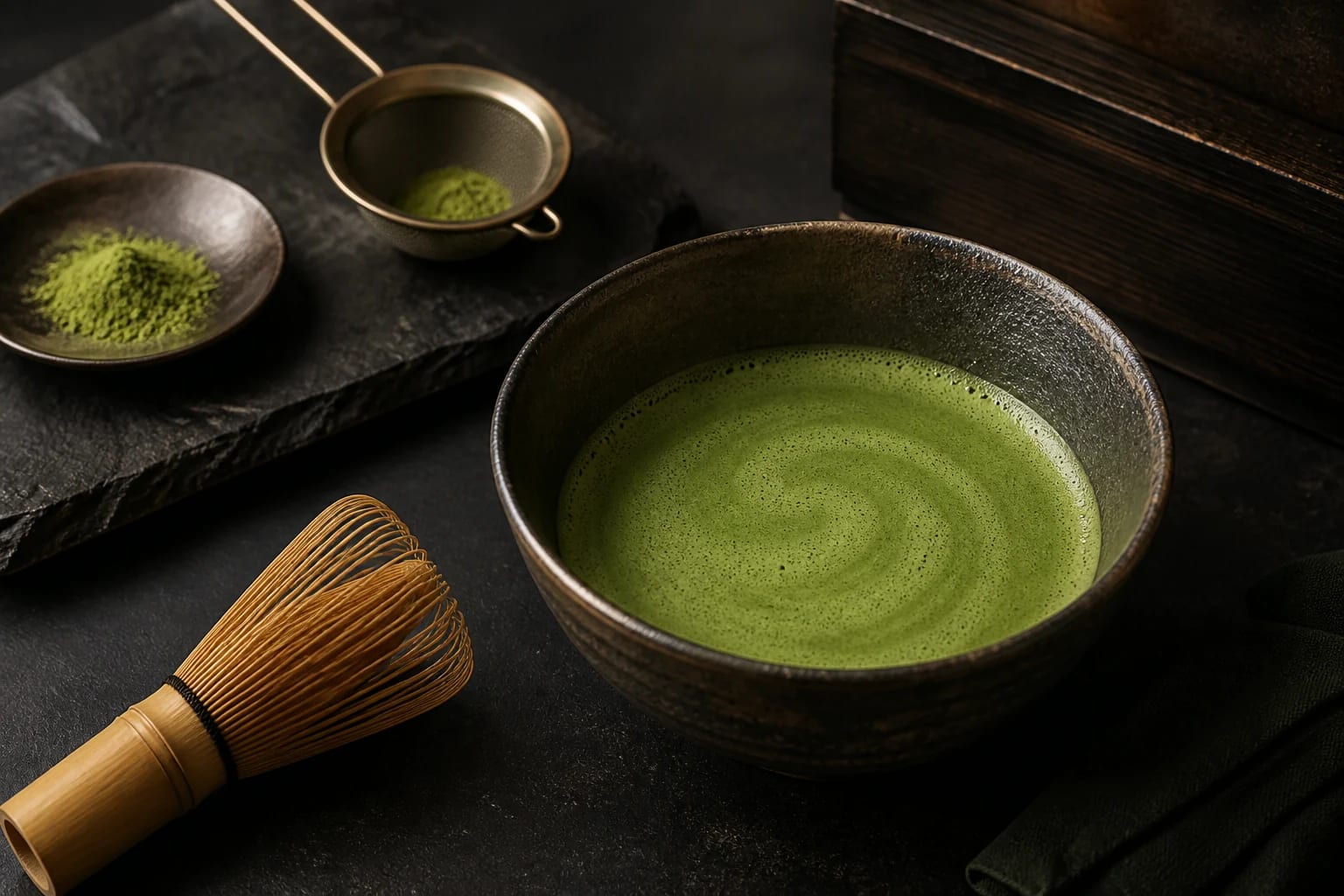
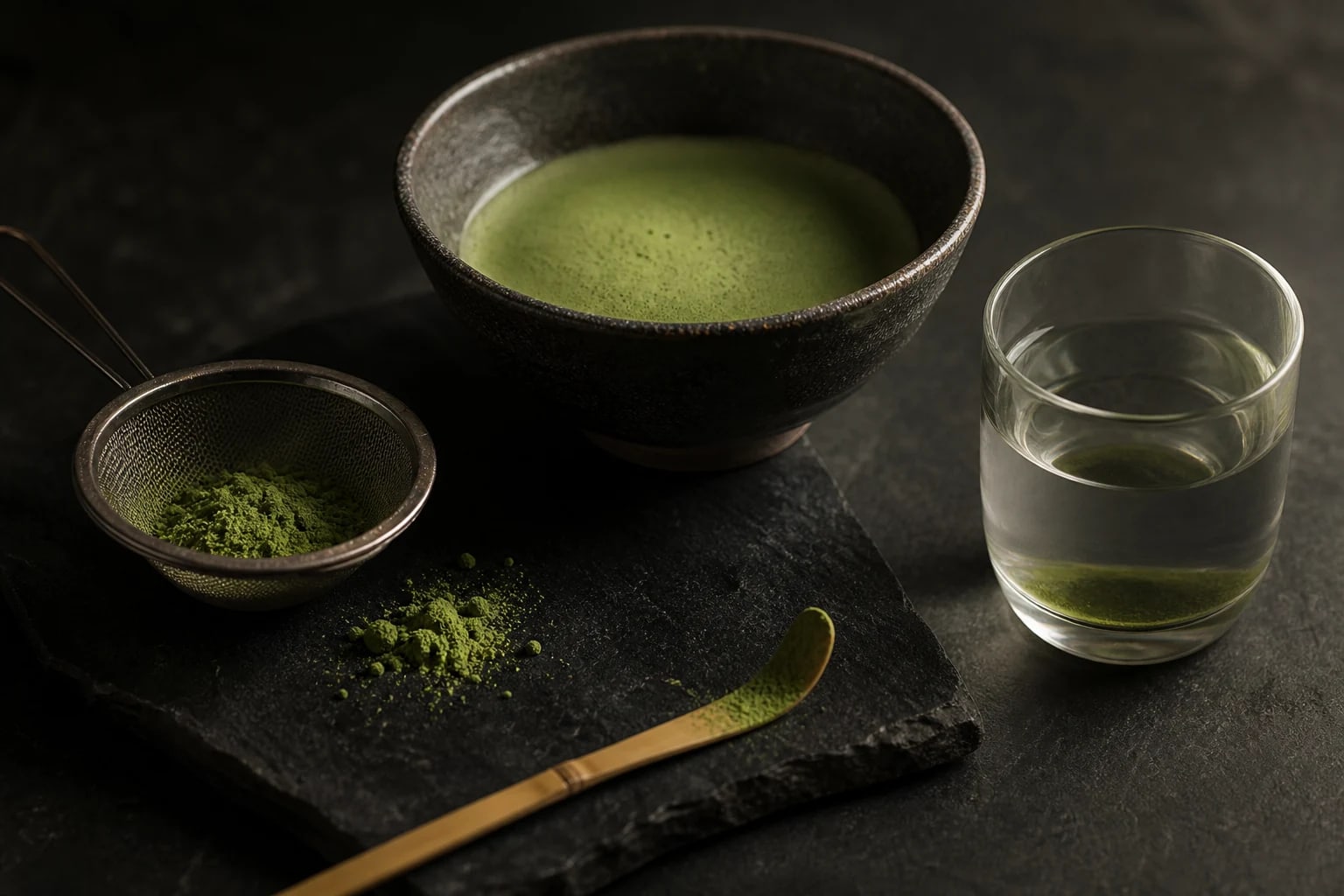
Matcha does not dissolve like sugar: part of its compounds pass into water, but the fine leaf particles remain in suspension. A slight deposit after a few minutes is therefore normal. Large dry lumps and a sandy texture, on the other hand, are reduced by sifting, pre-wetting the powder and serving quickly.
This distinction avoids two opposing errors: believing that a good matcha must become a perfectly transparent liquid, or accepting any compact mass at the bottom of the bowl. Successful preparation does not eliminate plant matter; she disperses it finely enough to obtain a pleasant and regular texture.
Solution, suspension and deposition: three different phenomena
In a solution, the solute is distributed on the molecular scale: the sugar visually disappears in the water. Matcha is a finely ground whole leaf powder. Some water-soluble molecules are extracted, while a significant portion of the solid matter remains in the form of dispersed particles. The bowl is therefore, as a whole, a suspension.
Over time, gravity and interactions between particles encourage them to gather and then settle. Whisking puts the particles back into motion, but does not turn them into dissolved molecules. A Japanese study on the production of fine matcha intended for processed foods also describes poor suspension as a technological issue and reports a wide size distribution for the conventional matcha studied. These industrial data do not define each Maison Genkai batch, but confirm the particulate nature of the product.
Another one study of technological properties on ten matcha products measured water solubility indices and variable water retention capacities. The behavior therefore also depends on the powder. Finally, fine particles contribute to foam, as shown by specific study on the foaming properties of matcha. Trying to remove any particle would mean removing part of what characterizes the drink.
Diagnosis: normal or improveable?
| Observation | Diagnosis and action |
|---|---|
| Thin layer at the bottom after several minutes | Normal sedimentation of a suspension — Stir gently or drink more quickly |
| Floating dry balls | Powder poorly wetted or not sifted — Sift then form a paste with a little water |
| Sandy texture from the first sip | Clumps, insufficient dispersion or coarser powder — Compare sifting, whisking and other batches |
| Hard block in bag | Compression or exposure to moisture — Check odor, packaging and storage conditions |
| Very quick deposit in a large glass | Long wait time or low agitation — Prepare ready to serve and remix before drinking |
1. Start with a dry bowl and utensils
A drop in the spoon or on the sieve is enough to stick the powder and form masses that are difficult to distribute. Dry the bowl if you are not using it immediately after reheating. Take the matcha with a clean, dry spoon, then close the bag without leaving it open throughout the preparation.
Humidity is particularly important when matcha is stored cold. Opening a cold sachet in a warmer room may cause condensation on the powder. Allow the closed container to return to room temperature before opening. Our complete guide explains how to store matcha after opening.
2. Sift without pretending to stir
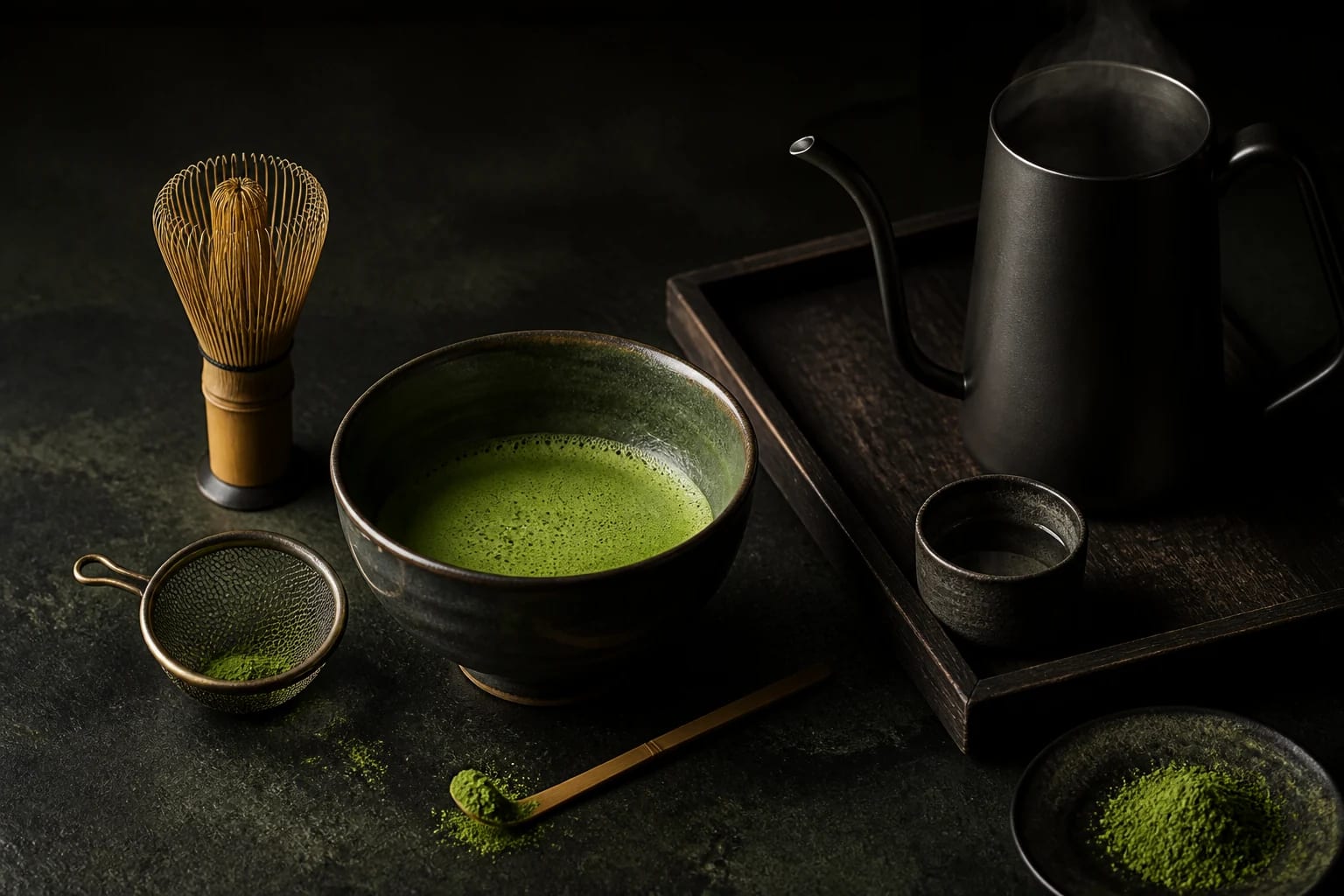
Place a fine sieve over the bowl and pass the dose through with the back of a spoon. The sieve breaks up the agglomerates formed during storage and aerates the powder; it does not change the particle size resulting from the grinding. This nuance matters: if the texture remains systematically coarse after proper sieving, the cause may not only come from your actions.
Weigh 2g to start. A very high dose mechanically increases the quantity of material to be dispersed and can thicken the last sip. The right dosage depends on the recipe, but a weighed base allows tests to be compared.
3. Pre-wet into a smooth paste
Instead of pouring the entire volume of water onto the powder, add about 10-15 ml first. Mix gently with the chasen or a small spoon until you obtain a homogeneous paste without dry pockets. Then add the rest of the water and whisk. This step increases the contact between powder and liquid before the clumps can float to the surface.
Water around 60–70 °C is a practical starting point for a hot bowl, without being an absolute standard. Boiling water is not necessary to “dissolve” the matcha and can accentuate the bitterness. Cold water also works, but pre-dispersion becomes even more useful.
4. Whisk to disperse, not to grind
The chasen should not crush the powder against the bottom like a pestle. After making the initial paste, whisk quickly back and forth with a short flick of the wrist. The currents created in the bowl separate clumps and temporarily keep particles suspended. Our guide to traditional and modern matcha preparation explains the movement and alternatives.
A small electric frother produces effective dispersion if its head remains submerged initially; too close to the surface, it mainly incorporates air and projects the powder. A closed shaker works well for cold drinks. Never shake hot liquid in a container that is not explicitly designed to handle pressure.
5. Respect the correct order for an iced latte
Pouring dry matcha over ice cubes and cold milk almost always creates islands that are difficult to catch. First prepare a smooth concentrate with the powder and a small volume of water, then pour it over the milk and ice. Mix before serving. OUR lump-free iced matcha latte recipe gives a reproducible order.
For coffee, the same logic applies to mise en place: pre-dosing the dry powder can be useful, but preparing a large diluted volume well in advance encourages settling and loss of texture. A concentrate must be homogenized just before assembly and used according to a hygiene and service protocol defined by the establishment.
6. Serve without unnecessary waiting
The best dispersion does not suspend particles indefinitely. Serve the bowl after whisking. If you drink slowly, a gentle circular movement of the bowl or spoon resuspends the material without restarting the entire preparation. In clear glass, a thin green line at the bottom alone does not indicate poor quality.
However, avoid leaving a milk drink at room temperature under the pretext of remixing it later. The usual food safety rules apply to lattes, regardless of matcha.
7. Recognize signals that deserve monitoring
Small crumbly clumps break easily in a sieve and are common. A damp block, sticky powder, musty odor or unusual visible marks require extra caution. Do not taste a product that smells like mold or whose packaging appears to have leaked water.
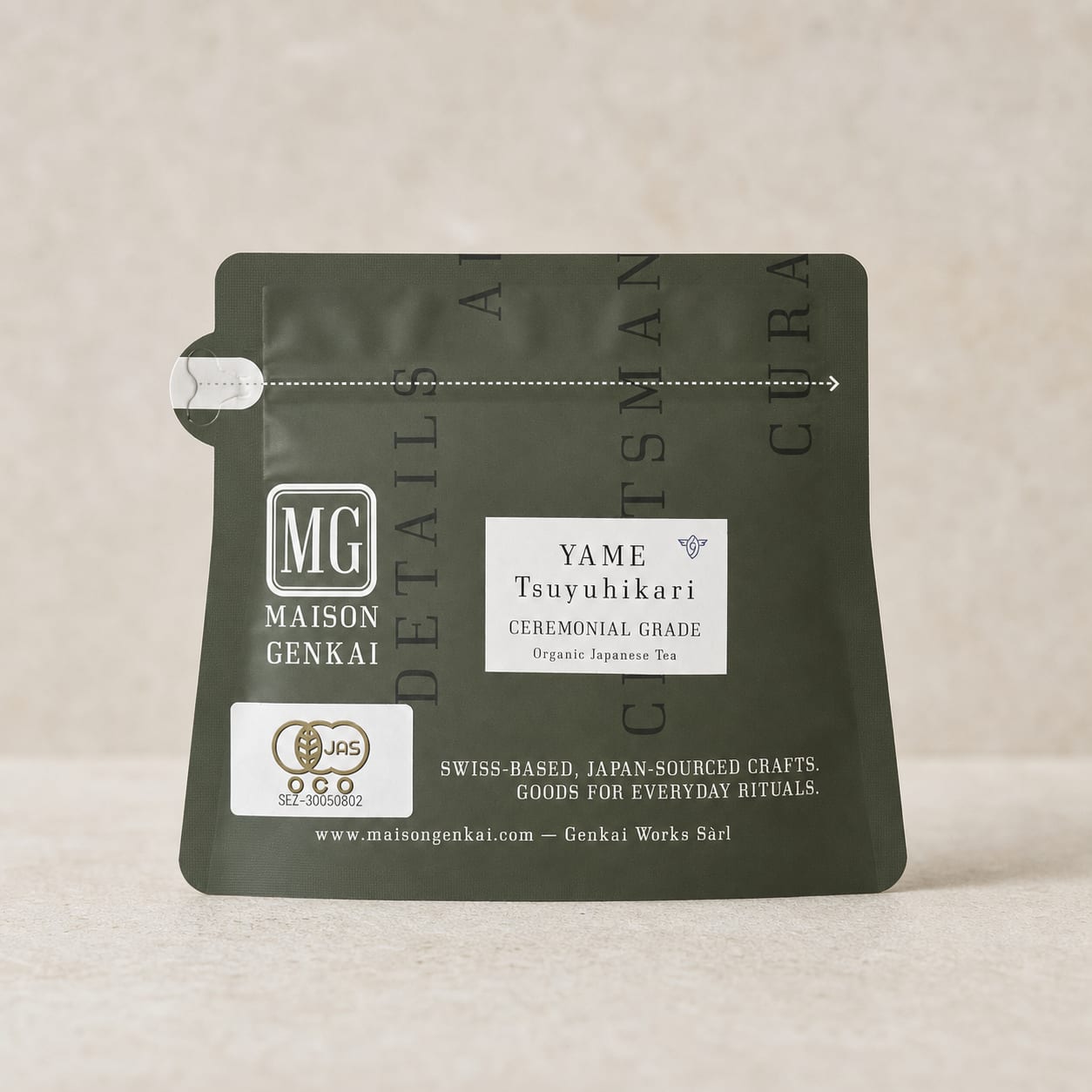
If the matcha appears sound but remains unpleasantly grainy despite controlled preparation, compare another product using the same protocol. Grind fineness and physical properties can vary. The organic Yame Tsuyuhikari Matcha, 40 g can be tested with the paste-then-whisk method; Maison Genkai does not present particle-size figures as specific to this batch without documented analytical measurement.
Anti-Lumps Checklist
- Bring the closed bag to room temperature if it was refrigerated.
- Use a perfectly dry bowl, sieve and spoon.
- Weigh 2 g and sift directly into the bowl.
- Add 10 to 15 ml of water and form a smooth paste.
- Top up with water then whisk without scraping the bottom.
- For an iced latte, add the concentrate before or over the milk, never the dry powder.
- Serve quickly and stir gently if a light deposit appears.
Frequently asked questions
Does a deposit at the bottom mean the matcha is of poor quality?
No. A slight deposit is compatible with the particulate nature of matcha. Quality is also judged by origin, freshness, taste, texture and traceability. An immediate strong granularity, however, merits checking the dispersion and the powder.
Why doesn't the sieve remove all the deposit?
Because it breaks up clumps without dissolving the leaf matter. Individual particles pass through the sieve and remain suspended in water; some naturally settle over time.
Should you use hotter water to dissolve matcha?
No. Hot water further extracts some soluble compounds, but it does not turn all of the powder into solution. Excessive temperature can also make the taste harsher. Instead, work on sieving, pre-wetting and stirring.
Does a blender permanently prevent sedimentation?
It disperses particles quickly, especially for multiple portions, but it does not remove gravity or make all material soluble. The drink should remain close to serving and be remixed if necessary.
In short: matcha involves both extraction and suspension. Accept a fine deposit, but remove dry clumps with a simple method: dry equipment, sifting, an initial paste, agitation and prompt serving. This precision lets the profile of teas from Yame, Fukuoka show clearly without promising physically unrealistic dissolution.
Sources
- Japanese Society for Food Science and Technology — production and characterization of fine matcha.
- Molecules — compounds and technological properties of matcha powders.
- Japanese Society for Food Science and Technology — matcha particles and foam.
Read next
To go further, see How to Prepare Matcha: Traditional and Modern Methods, then Matcha FAQ: Everything You Need to Know (2026). For a complementary angle, also read How to Store Matcha After Opening.