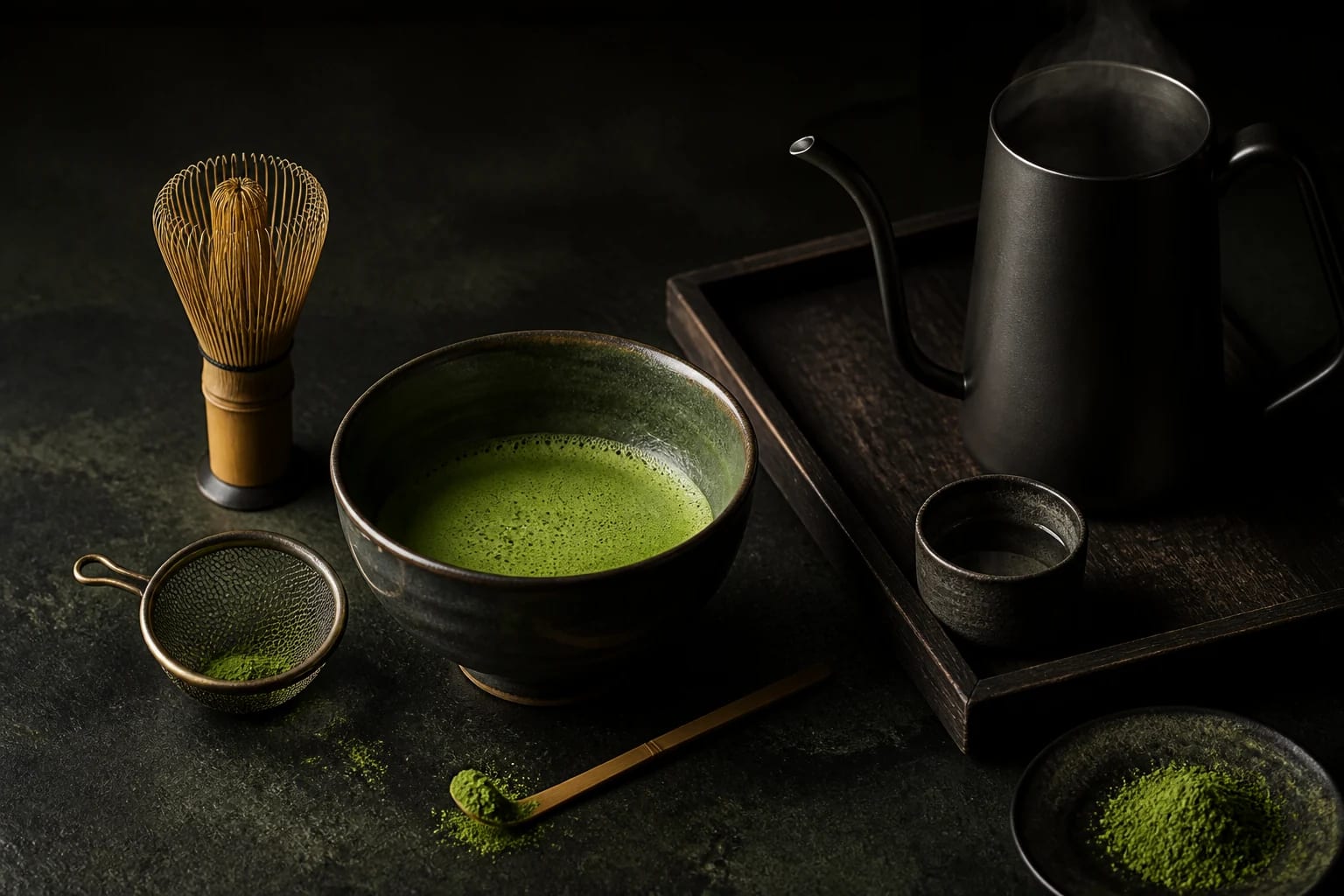
Why Is My Matcha Bitter? A Six-Step Diagnosis
A matcha that is too bitter most often comes from an excessive dosage, water that is too hot, a water-powder ratio that is too concentrated or a powder that does not correspond to the intended use. Fix one variable at a time: start with 2g of matcha, 60-70ml of water at 60–70°C, then adjust to suit your palate.
Bitterness is not always a fault, however. Matcha naturally contains bitter and astringent compounds. A balanced bowl can therefore have a slight bitterness, supported by umami and a sweet sensation. The goal is not to make the tea neutral, but to prevent a single sensation from masking everything else.
Bitterness or astringency: identify the right sensation
Bitterness is a flavor perceived by the tongue, comparable – without being identical – to that of black coffee or certain vegetables. Astringency is a tactile sensation: the mouth seems drier, the gums tighten and saliva seems less present. Both can coexist in green tea, but they don't always correct each other in the same way.
Research work on green tea notably associates bitterness with caffeine and certain catechins, while amino acids participating in umami modulate overall perception. A sensory study on ready-to-drink green teas identified EGCG, caffeine, glutamic acid and theanine as important contributors to the taste profile. Another one study on the interaction between catechins and umami amino acids shows that the balance between these compounds matters as much as their isolated presence. These studies shed light on the mechanism of taste; they do not constitute a preparation standard specific to Maison Genkai matcha.
Quick diagnosis: which variable to test first?
| Symptom | Diagnosis and action |
|---|---|
| Immediate and dominant bitterness | Water too hot or dose too high — Descend to 60–70 °C and weigh 2 g |
| Very dry mouth after sip | Strong extraction or unfavorable water — Reduce the temperature then compare low mineralized water |
| Flat taste then harsh finish | Old or poorly protected matcha — Check odor, color and storage after opening |
| Persistent bitterness after several controlled trials | A naturally more bitter cultivar profile, less refined raw material or insufficient quality for the intended use — Compare another matcha at the same dose, water and temperature |
| Bitter latte despite lots of milk | Concentrated powder, unbalanced milk or masking sugar — Return to a recipe weighed before adding sugar |
| Different result every day | Dosage, volume or temperature estimated by eye — Set a protocol and only modify one parameter |
1. Weigh the powder instead of using a rough scoop
A spoon is not a stable unit: the powder can be packed, rounded or more aerated depending on the sachet. A minimal visual difference is enough to significantly modify a small bowl. To establish a point of comparison, weigh 2 g of matcha with a tenth of a gram scale. Add 60 to 70 ml of water. This protocol is not a universal rule; it’s a repeatable foundation for understanding what you like.
If the bowl remains too intense, add 10 ml of water before reducing the quantity of powder. You thus maintain an interesting texture while reducing concentration. If the result becomes too light, return to the initial volume rather than multiplying the corrections at the same time.
2. Reduce water temperature
Boiling water can make the profile harsher and mask soft or vegetal nuances. THE Japanese Ministry of Agriculture recalls, for Japanese green tea in general, that temperature influences the extracted compounds and that high temperatures further favor the expression of bitterness and astringency. This indication relates to the infusion of green tea and does not in itself set an official temperature for all matchas.
In practice, test 60–70°C. Without a thermometer, pour the boiled water into a clean intermediate container, wait briefly, then use it. For a precise diagnosis, a thermometer is preferable: “wait a minute” does not produce the same result depending on the kettle, the volume and the temperature of the room.
3. Examine the water-to-powder ratio
Two grams in 40 ml makes a much more concentrated drink than two grams in 70 ml. This obvious fact is easily lost when playing a video without measuring the bowl. Start with a stable ratio, then gradually lengthen. A matcha intended to be enjoyed neat can be expressive without being aggressive; a matcha chosen for the latte must retain enough presence against the milk.
Our guide to traditional and modern preparation of matcha details the order of the gestures. This diagnosis pursues another goal: to isolate the cause of excessive bitterness rather than seeking perfect foam.
4. Test the water used in Switzerland
Tap water varies depending on the municipality, the network and sometimes the season. Very mineralized water or marked by a chlorine odor can modify the aromatic perception and texture. It would be unwise to declare that a Swiss town always has “good” or “bad” water: consult the analysis from your local distributor and do a simple test.
Prepare two identical half portions, one with your usual water, the other with lightly mineralized water with a neutral taste. Keep dose, temperature and gesture constant. If the difference is clear, a suitable filter or different water may be more useful than immediately purchasing a different matcha.
5. Control freshness, odor and conservation
Air, light, heat and humidity gradually degrade the sensory profile of matcha. Powder that has been opened for a long time may lose its vibrancy and appear duller or harder. Check that the bag is tightly closed, stored away from odors and handled with a perfectly dry spoon. Our guide explains in detail how to store matcha after opening, including precaution against condensation when refrigerated.
A less bright color alone is not enough to conclude that a matcha is unsuitable. On the other hand, a frankly rancid, damp or foreign smell justifies not trying to mask the problem with milk or sugar. If in doubt about the integrity of the product, do not consume it.
6. Check that the matcha is suitable for use
The word “ceremonial” guarantees neither a universally mellow profile nor, by itself, a verifiable level of quality. It is not a grading scale harmonised across brands: ISO defines matcha and its characteristics, but does not create a “ceremonial grade” certification. A high price is therefore no substitute for a clear description.
Cultivar, harvest, shading, raw material, milling, freshness and producer choices all interact. If bitterness remains dominant after trials made with the same dose and temperature, it may reveal less refined leaves or sorting, less careful manufacture, or more generally a level of quality objectively insufficient for drinking neat. But it may also come from a cultivar profile naturally richer in bitter compounds and less driven by umami. In that second case, “more bitter” does not automatically mean “bad”: the matcha may be well made but less suited to your palate or a delicate usucha, while performing better in a latte or recipe.
When buying, do not rely on the word “ceremonial” alone. Look for origin, harvest, cultivar when known, recommended use and above all a precise sensory description; ask whether the matcha is intended for water, lattes or cooking. If you're just starting out, our guide which matcha to buy according to taste and use allows you to choose without reducing quality to color. For daily use or as a latte, the organic Yame Yabukita Matcha, 40 g constitutes a coherent option; always start with a measured recipe before changing the dose.
What if matcha turns bitter in a latte?
First prepare a smooth concentrate with the powder and a small amount of water, then add the milk. Pouring the powder directly into a tall glass of cold milk promotes lumps and makes the dosage difficult to assess. Very sweet milk can give a sweet first impression while leaving a harsh finish; adding more syrup masks the diagnosis without solving it.
Test the base in water before assembly. If it is balanced but disappears in the milk, increase the dose slightly or reduce the volume of milk. If it is already aggressive, correct temperature and ratio first. The type of milk, its temperature and its own sweetness then influence the final balance.
Checklist for a more balanced bowl
- Weigh 2g of matcha instead of filling a spoon randomly.
- Measure 60–70 ml of water and aim for 60–70°C for the first try.
- Sift the powder and whisk without crushing it against the bottom.
- Taste before adding milk, sugar or syrup.
- Change a single variable, then note the result.
- Compare water only with identical protocol.
- Immediately close the bag with a dry utensil.
Frequently asked questions
Should a good matcha be completely free of bitterness?
No. A slight bitterness can be part of a balanced profile. The problem arises when it dominates to the point of erasing umami, vegetal notes and texture, or when strong astringency leaves the mouth uncomfortably dry.
Should you add sugar to correct bitter matcha?
Not as a first resort. Sugar can balance a chosen recipe, but it does not correct too hot water or an overdose. First stabilize the base with water; then sweeten according to the style of drink desired.
Why does the same matcha seem bitterer some days?
The dose, temperature, volume of water, time elapsed after preparation and even the product consumed just before can change perception. A weighed protocol makes it possible to distinguish the variability of preparation from that of tea.
Should I change matcha if the first test is bitter?
First do two or three controlled trials. If a lower temperature and a less concentrated ratio do not restore balance, compare another matcha using exactly the same protocol. You can then distinguish more reliably between a defect or less refined raw material, a naturally more bitter cultivar, and a product that is simply mismatched with your palate or intended use.
In short: weigh, cool, measure and compare. A stable method quickly reveals whether the bitterness comes from the preparation, the water, the freshness or the choice of matcha. Maison Genkai exclusively selects its teas in Yame, Fukuoka; the best setting remains the one that respects this profile while suiting your palate.
Sources
- MAFF — role of temperature in the preparation of Japanese green tea.
- Journal of Food Science — interaction between catechins and umami amino acids.
- Food Chemistry — compounds contributing to the taste of green tea.
- Food Chemistry: X — influence of tea variety on matcha composition and sensory profile.
- ISO/TR 21380:2022 — matcha definition and characteristics.
Read next
To go further, see How to Prepare Matcha: Traditional and Modern Methods, then Why Won’t My Matcha Foam? Seven Testable Causes. For a complementary angle, also read Matcha FAQ: Everything You Need to Know (2026).