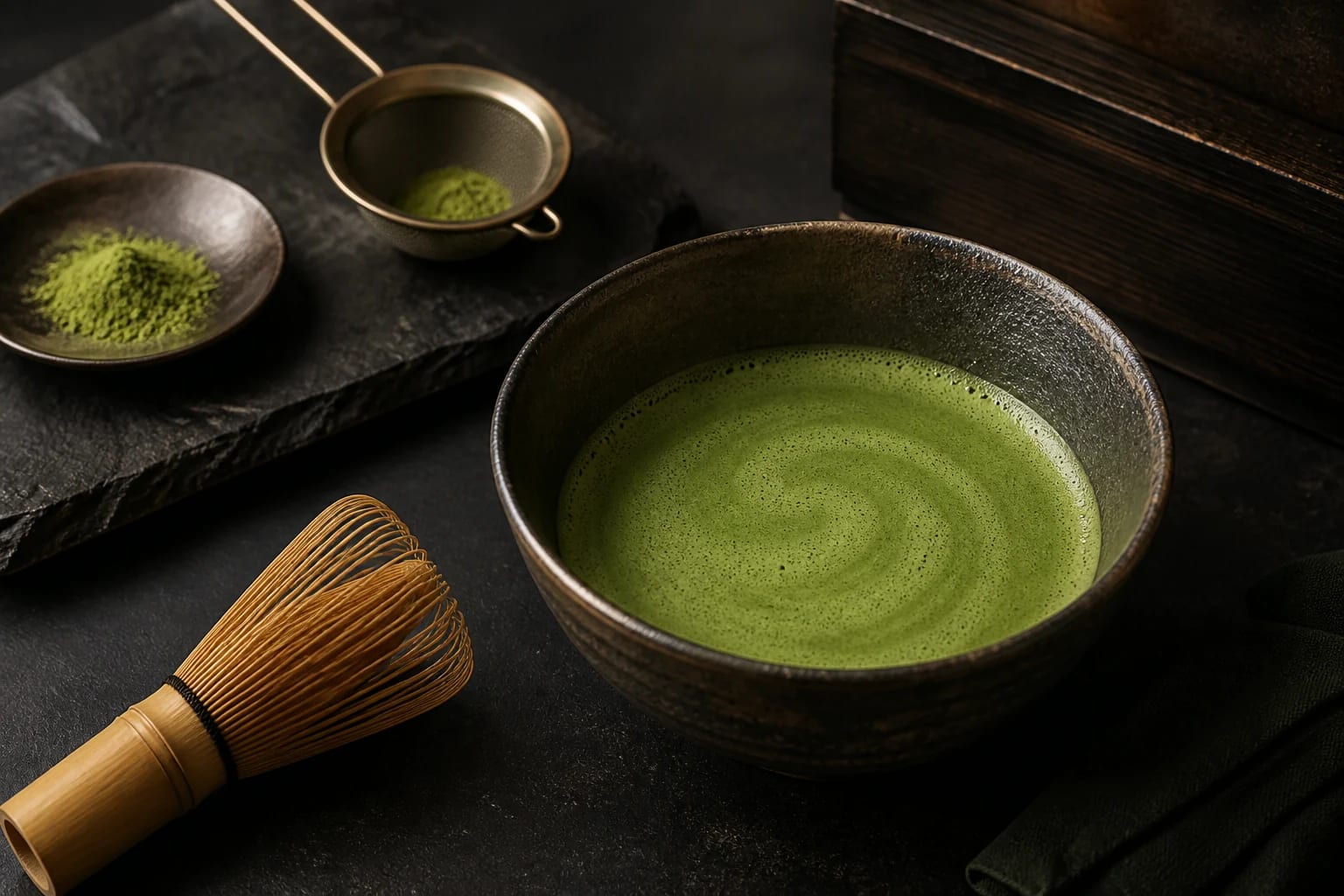
Why Won’t My Matcha Foam? Seven Testable Causes
Matcha that produces little foam is not necessarily poor quality. Foam depends on the bowl, whisk, water volume, technique and the powder’s properties. To diagnose the problem, sift 2 g, add 60–70 ml of water, use a wide bowl and whisk quickly from the wrist without pressing against the bottom.
Foam is a desired texture in certain preparations, not a certificate of quality. A matcha can offer remarkable taste with a thin layer, while an abundant foam proves neither the origin, nor the freshness, nor a particular “grade”. The objective is therefore to understand what is controllable without transforming the number of bubbles into an absolute verdict.
What Science Really Says About Matcha Foam
A Japanese study devoted to the foaming properties of matcha indicates that the foam results from the joint action of soluble components and fine particles. Soluble components also contribute to stability, while particles localize at the bubble membrane. The cup is therefore not a simple soapy liquid: it is a complex system where water, air, dissolved substances and plant matter interact.
A study published in Food Chemistry on several matcha powders also observed that pH and different components — including polyphenols, amino acids, soluble proteins and pectins — influence the formation or stability of the foam. The results varied depending on the raw materials studied. They do not allow us to promise that a Yame matcha will always produce a specific height, but they confirm that a difference in powder can remain even with an identical gesture.
Finally, a Japanese document on sensory examination of matcha includes foam among several criteria, alongside color, particle size, aroma and taste. This puts the foam back in its rightful place: an indicator among others, never a complete judgment.
Diagnostic table
| Observation | Diagnosis and action |
|---|---|
| No foam, big slow movements | Insufficient speed and trajectory — Use the wrist with a quick M or W movement |
| The chasen catches the bottom | Narrow bowl or excessive pressure — Choose a wide bowl and lift the strands slightly |
| Large bubbles that disappear quickly | Gesture too high or irregular — Whisk just below the surface then smooth briefly |
| Lumps despite visible foam | Unsieved or wet powder — Sift into a perfectly dry bowl |
| Variable foam with the same method | Variable measurements or powder — Weigh 2 g and set water, temperature and time |
1. Use a large enough bowl
The chasen must be able to move quickly without continually hitting the walls. In a tall and narrow cup, the amplitude is reduced, the whisk becomes blocked and we often compensate by pressing harder. A wide chawan with a relatively open bottom creates a more comfortable work area. It doesn't have to be perfectly smooth or standardized; Above all, he must let the strands move freely.
Place the bowl on a stable surface. Hold it in one hand and whisk with the other. An unstable position requires you to slow down and transforms the movement of the wrist into a large gesture of the forearm, less precise and more tiring.
2. Prepare the chasen without damaging it
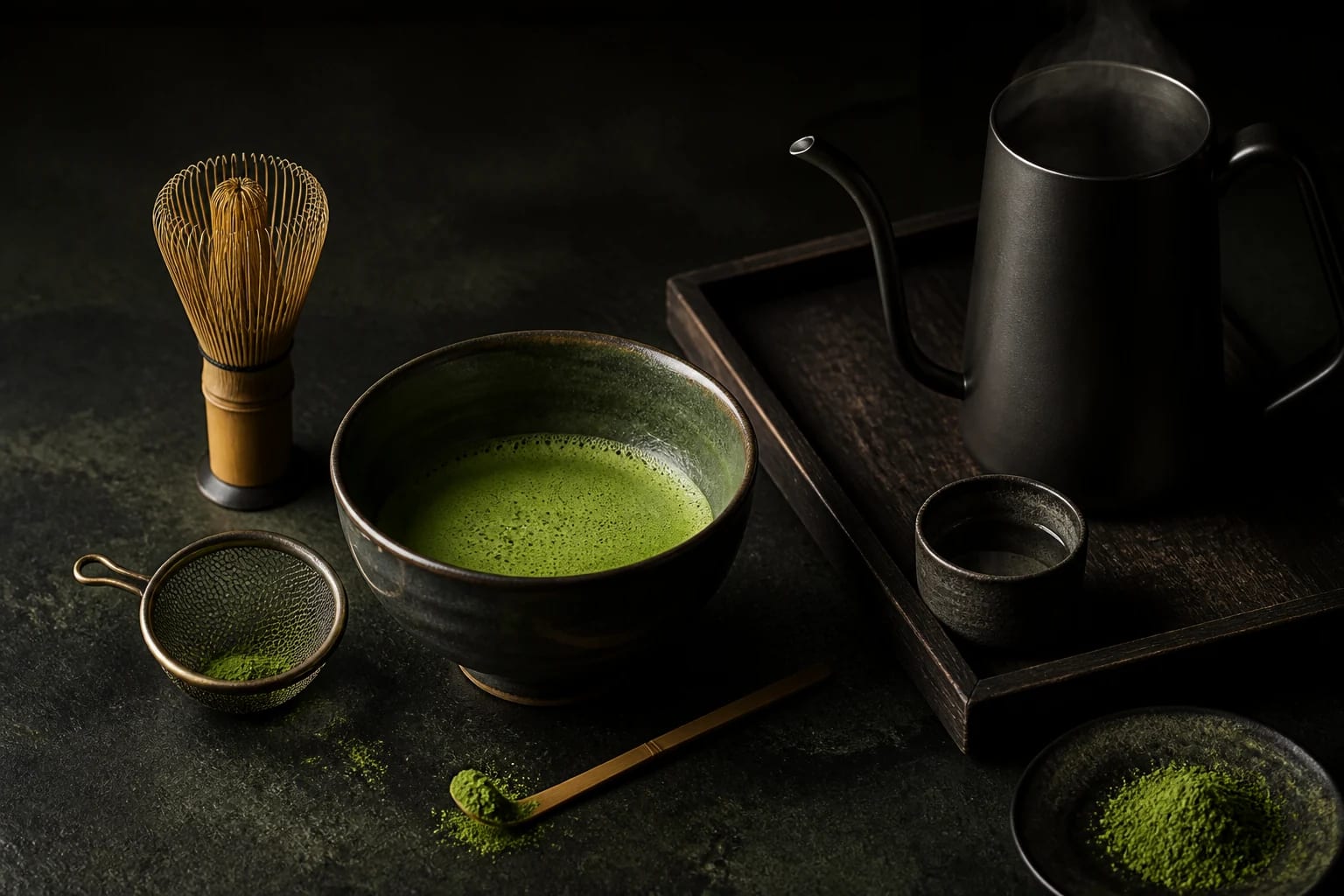
A very dry bamboo whisk is more brittle and less flexible. Moisten the strands for a few moments in clean lukewarm water before preparation, without immersing the handle for a long time or letting it soak after use. Inspect the bristles: a few ends that open over time are normal, but a whisk that is severely broken, warped, or has a suspicious odor should be replaced.
After use, rinse it with clean water, gently remove any residue and let it dry completely in a ventilated space. Storing it while still damp in a closed container promotes odors and mold. Do not use scented dishwashing liquid on bamboo.
3. Sift the powder
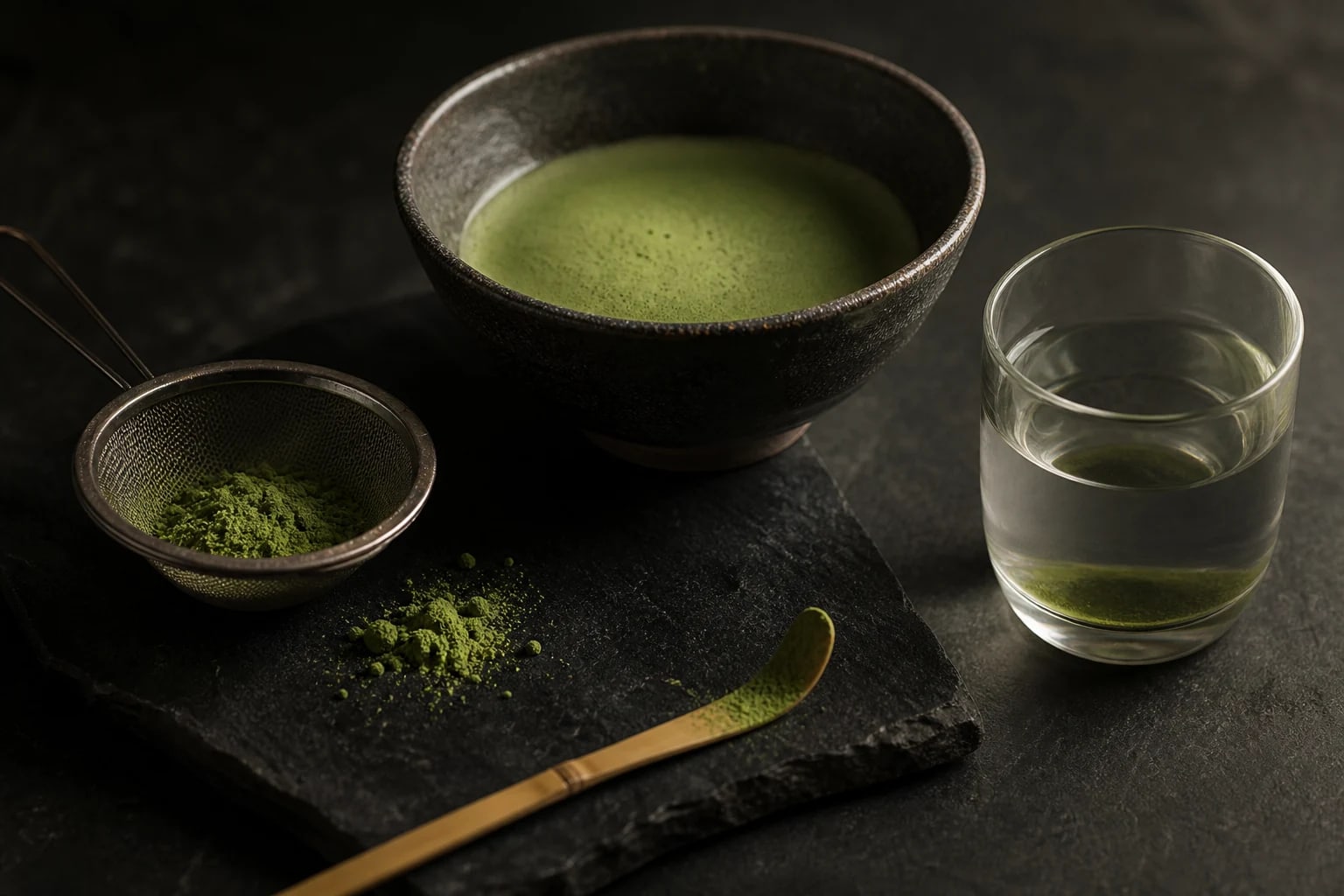
Matcha easily absorbs moisture from the air and forms agglomerates. The sieve does not reduce the intrinsic size of the ground particles; It mainly breaks up the clumps and distributes the powder. This step facilitates uniform wetting and avoids spending the first seconds of whipping chasing dry pockets.
Sift 2 g directly into the dry bowl. Use a dry spoon to pass the powder, then add the water immediately. Immediately close the bag. For the conservation and management of condensation, consult our guide store matcha after opening.
4. Stabilize dose, water and temperature
A large quantity of water in a small bowl reduces the available space and increases the risk of splashing; a tiny amount produces a concentrate that is more difficult to aerate. To compare two techniques, start with 2 g and 60 to 70 ml. This is a practical test protocol, not a universal standard.
Water around 60–70 °C is suitable for a balanced first test. Very cold, it sometimes wets the masses less easily; boiling, it can harden the taste and does not compensate for a bad gesture. Measure at least when diagnosing. Our article on traditional and modern preparation presents method variations.
5. Whisk with your wrist, without crushing the bottom
Hold the chasen with a light grip. Place the strands in the liquid, but do not press them against the ceramic. Whisk quickly back and forth, in a short M or W trajectory. The movement comes mainly from the wrist; the shoulder and elbow remain relaxed. Large circles mix the liquid, but generally incorporate air less efficiently.
After about 15 seconds, bring the whisk up slightly near the surface to refine the bubbles, then slow down and draw a gentle circle before removing the chasen. The exact time depends on the gesture and the bowl; continue until you obtain a uniform texture rather than following a rigid timer.
6. Accept that not all powders foam the same way
Composition, particle size and shape, raw material and manufacturing influence behavior in water. Two matchas whipped by the same person can therefore produce different foams. This doesn't automatically mean one is real and the other fake, or that the frothier is the tastier.
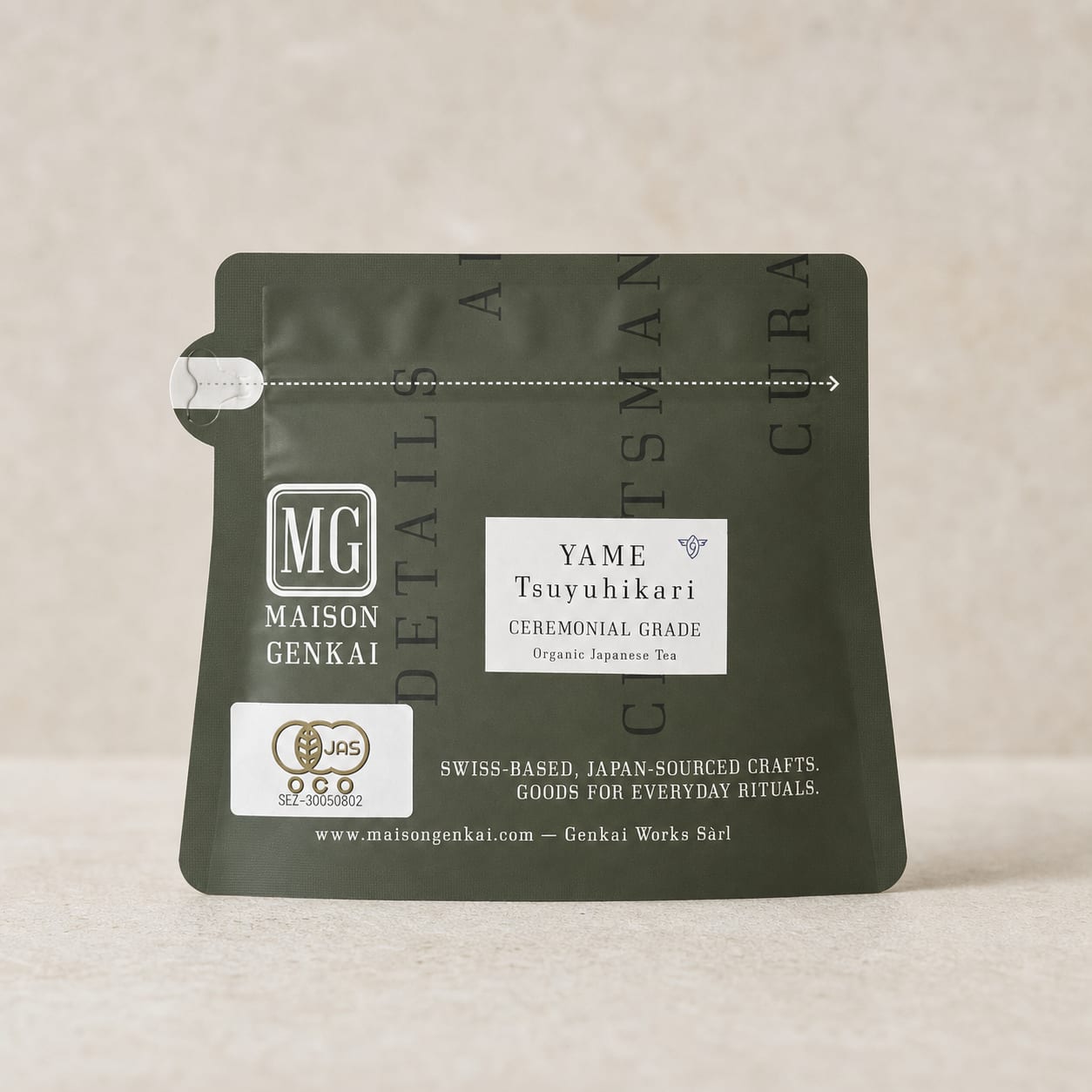
Also evaluate the aroma, the balance between umami and bitterness, the texture, persistence and traceability. The organic Yame Tsuyuhikari Matcha, 40 g can be tasted with this protocol, but Maison Genkai does not promise a fixed foam height: the water and the technique of each preparation remain decisive.
7. Choose a suitable tool if you don’t have a chasen
A small electric frother can quickly incorporate air, but it sometimes creates large bubbles and throws the concentrate out of a shallow container. A closed shaker effectively disperses a cold preparation; open it carefully and never shake very hot liquid into a container not designed for pressure. A blender is disproportionate for a single bowl but useful for several portions served immediately.
For a latte, it is often enough to obtain a smooth base rather than a perfect traditional foam: the milk then provides its own texture. The method of our coffee quality matcha latte recipe allows you to separate the dispersion of matcha and the frothing of milk.
Checklist before changing matcha
- Choose a stable, wide and perfectly clean bowl.
- Briefly soften the chasen and check its condition.
- Sift 2 g of powder with dry utensils.
- Measure 60 to 70 ml of water around 60–70 °C.
- Whisk quickly with your wrist without scraping the bottom.
- Modify only one variable during the next test.
- Judge taste and texture, not just foam height.
Frequently asked questions
Does the foam prove that a matcha is ceremonial grade?
No. The foam depends on the composition of the powder and the preparation. The term “ceremonial” is also not a universal legal norm. Origin, traceability, freshness and sensory profile are more informative than a photo of foam.
Why do I have large bubbles rather than fine foam?
The whisk may be too close to the surface, the movement too broad or the final smoothing missing. Work just below the surface first with a short path, then finish more gently to even out the bubbles.
Can you froth cold matcha?
Yes, especially with a shaker or frother, but the result differs from a hot bowl whipped with chasen. Pre-dispersing the powder in a small volume generally facilitates a consistent cold drink.
Does foam that falls quickly mean that the matcha is old?
Not on her own. Stability depends on the powder, water, bowl, amount of air and gesture. Check freshness separately by smell, storage, appearance and taste consistency.
In short: treat foam as a result of preparation, not as a label. Measure, sift, use a large bowl and a light, quick gesture. Maison Genkai matchas come exclusively from Yame, Fukuoka; their expression in the cup deserves to be evaluated by the complete taste, with or without a thick layer of foam.
Sources
- Japanese Society for Food Science and Technology — particles and foaming properties of matcha.
- Food Chemistry — physicochemical mechanisms of matcha foam formation.
- Tea Research Journal — sensory review of matcha.
Read next
To go further, see How to Prepare Matcha: Traditional and Modern Methods, then Why Is My Matcha Bitter? A Six-Step Diagnosis. For a complementary angle, also read How to Choose Matcha: 2026 Buying Guide.