Organic Matcha in Switzerland: Certification and Choice
In Switzerland, the word bio is not merely a marketing promise. It denotes a regulated, controlled and certified mode of production. But organic matcha is not automatically fresh, delicate, sweet or suited for pure tasting. The certification answers a precise question — how the tea was cultivated and processed — while the quality in the cup also depends on the origin, cultivar, harvest, shading, grinding and packaging.
This guide allows you to read a label or sachet with method. It does not rank brands and does not use « ceremonial » as an absolute shortcut. The aim is to distinguish verifiable guarantees from quality indicators, then to choose a matcha consistent with its use and its taste.
What « organic » really means in Switzerland
The Federal Office for Agriculture clarifies that only certified goods may bear the designations « organic » or « ecological ». Companies that produce, process, trade or import organic products are subject to regular inspections by an accredited body. The framework therefore covers the entire chain, not just the field where the tea grows.
Switzerland does not have a single state organic logo. Private labels may go beyond the legal minimum, but they must at least comply with the Swiss Ordinance on Organic Farming. The Bio Suisse Bud is thus a recognised private code of practice; the absence of the Bud does not automatically mean a product is not organic. It simply means that two levels of reference should not be confused.
For an imported food product to be organic, the SECO reminds that Swiss requirements for organic products must be met. In practice, the consumer must be able to identify a coherent designation, the origin and the responsible operator. A vague formula such as « grown naturally » does not equate to certification.
Organic JAS, Bio Suisse and private labels : do not confuse them
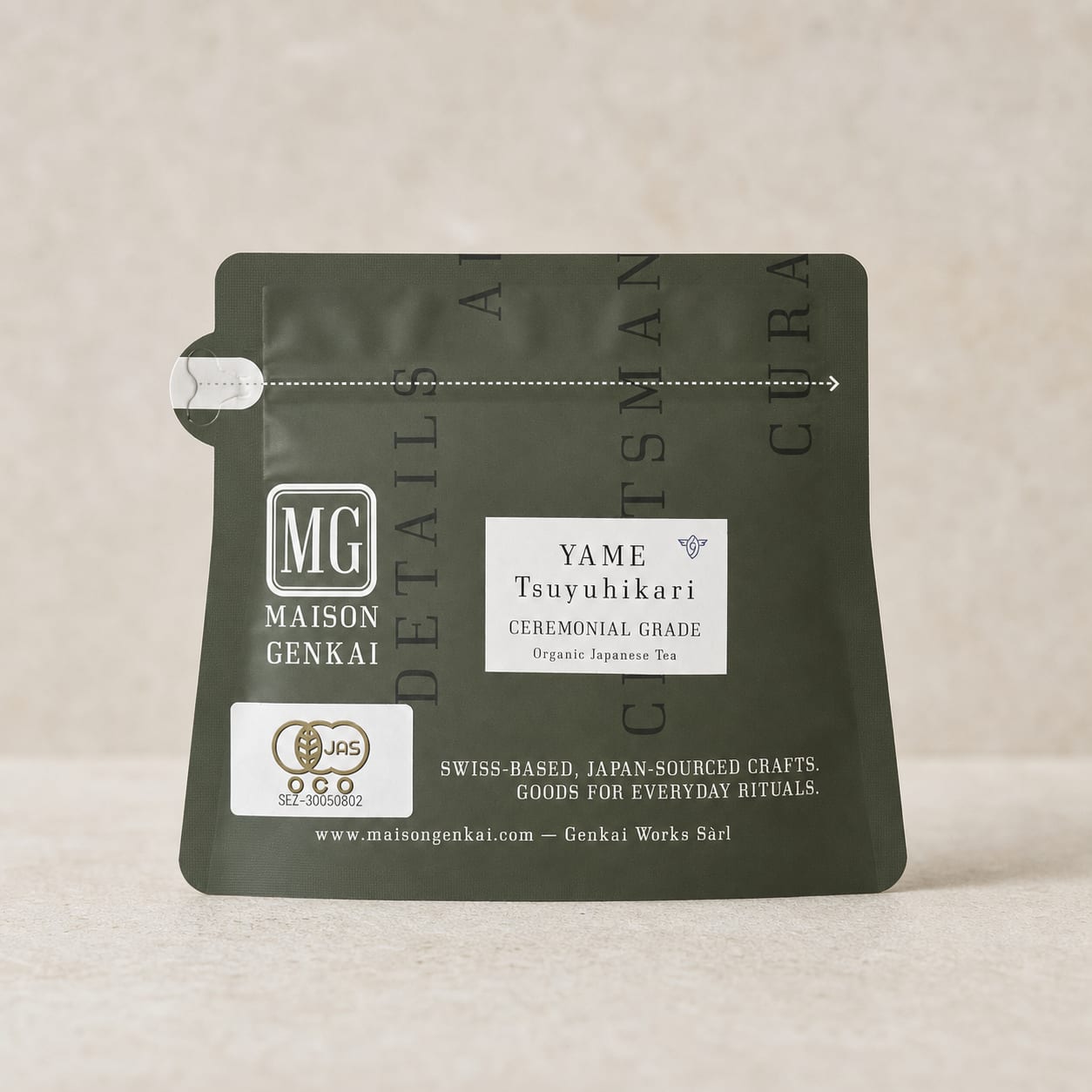
In Japan, the Organic JAS logo is the official reference for organic agricultural and food products under the Japanese system. It certifies that a certified operator complies with the applicable JAS standard. Maison Genkai's Yabukita and Tsuyuhikari sachets bear this logo alongside a visible certifying body code. This is concrete and verifiable information on the actual packaging.
Organic JAS is, however, not the Bourgeon logo and should not be presented as such. The systems pursue a comparable objective of organic production control, but they rely on different texts, certifying bodies, and sometimes additional requirements. A serious seller names exactly the certification displayed rather than transforming all labels into an indistinct « premium organic ».
The correct reading is therefore simple: identify the logo, verify that it is associated with the product and the operator, then distinguish this proof from the sensory discourse. The certification describes a mode of production. It makes no promise of total absence of any measurable trace, nor of superior taste, nor of a particular harvest.
Bio does not automatically mean better matcha
Two certified organic matchas can produce very different bowls. Certification does not specify the cultivar, the shading duration, the harvest date, the tencha sorting, the grind fineness, or the time between production and consumption. Yet these parameters directly influence colour, texture, umami, astringency and persistence.
Conversely, an uncertified matcha may come from a meticulous producer and offer great sensory quality. Without a certificate, it must simply not be sold as organic. To buy intelligently, you must therefore ask two separate questions: is the organic status demonstrated? and do the tea characteristics correspond to my usage?
The term « ceremonial grade » deserves the same caution. It does not exist as a universal legal classification in Japan. It may indicate a positioning intended for pure consumption, but factual information must still be examined. Our guide on matcha grades explains why usage is more useful than an isolated marketing hierarchy.
Seven criteria to check before buying
1. A precisely named certification
Look for a logo, and when the label allows, an accrediting body code. « Bio », « organic » or « écologique » should not float alone on a page without coherent information about the product. A transparent brand knows whether it is talking about Organic JAS, Swiss ordinance, a private label or another recognised certification.
2. A more precise origin than « Japan »
The country is essential, but a prefecture or production area adds more traceability. Maison Genkai sources its teas from Yame, in the prefecture of Fukuoka. This precision does not automatically make every batch excellent; it nevertheless allows linking the product to an identifiable supply chain rather than a generic origin.
3. The cultivar or blend composition
A monocultivar allows exploring a more readable profile, while a blend can seek balance and consistency. Neither is intrinsically superior. When the cultivar is named, such as Yabukita or Tsuyuhikari, the choice becomes more precise and can be confirmed at tasting.
4. The intended use
For usucha, sweetness, texture and finish clarity count a lot. In a latte, the tea must also remain perceptible against the milk. In baking, intensity, colour and cost per gram become decisive. Buying the most expensive product for all preparations is rarely rational.
5. The format and protection
Matcha fears air, light, heat and humidity. A small opaque and resealable sachet can be more pertinent than a large open container for months. A 40 g format represents approximately twenty bowls at 2 g: it is small enough to be finished quickly in a regular household.
6. Storage information
A serious label indicates how to protect the product after opening. Maison Genkai bio sachets recommend refrigerated and well-closed storage. You must then leave the packet closed to return to room temperature before opening, to avoid that the air's humidity condenses on cold powder. Our dedicated guide to storage details this protocol.
7. A sensory description attributed to the batch
Terms such as floral, vegetal, deep or velvety are useful if they guide the choice, but they do not replace a tasting. The cultivar, terroir and production interact. A good sheet avoids asserting that a cultivar always has exactly the same taste, regardless of producer or year.
Yabukita or Tsuyuhikari: two readings of Yame organic matcha
Both Maison Genkai organic references are Yame monocultivars, packaged in 40 g sachets and presented for ceremonial consumption. Their common point is therefore clear: same sourcing area, same format, visible JAS Organic certification and declared four weeks of shading.
The Yame Yabukita organic matcha is described with deep umami, vegetal notes, a soft texture, a creamy foam and a slight bitterness. It suits those seeking a structured, vegetal and familiar expression of Japanese tea.
The Yame Tsuyuhikari organic matcha highlights floral and vegetal notes, a velvety texture, a creamy foam and a gentle bitterness. It may appeal to a connoisseur who prefers a more aromatic and supple cup. These descriptions are those of the lots and sachets on sale; they do not claim to summarise all teas produced with these cultivars.
Which matcha should you choose for your preparation?
For a pure tasting, begin with 2 g of powder and 60 to 70 ml of water around 60–70 °C. This preparation directly exposes the balance between umami, vegetal, bitterness and texture. If you prefer classic and structured profiles, Yabukita constitutes a natural starting point. If you are looking for more floral relief, Tsuyuhikari offers a coherent alternative.
For a latte, both can work, but the milk attenuates the subtle nuances. It is useful to test first 2 g with a lightly sweetened milk, then adjust. If the matcha disappears, increase the dose slightly before adding sugar: a recipe that is too sweet masks the comparison and increases the cost without improving the tea.
If your priority is simply to order Japanese matcha delivered in Switzerland, the transactional page gathers the entire range. This article retains another function: to verify the organic status and to choose according to readable criteria, without inventing a universal superiority.
Frequently asked questions
Is Organic JAS matcha automatically Bio Suisse certified?
No. Organic JAS is an official Japanese certification; the Bourgeon Bio Suisse label is a private Swiss certification with its own code of practice. You must identify the specific system displayed and verify the applicable import and commercialisation rules in Switzerland.
Does organic guarantee the absence of pesticides?
Organic strictly regulates practices and authorised substances, but an absolute claim of « zero trace » requires specific batch analysis. The exact formulation is important: biological certification and analytical results are not the same proof.
Why do two organic matchas have different prices?
Cost also depends on yield, harvest, shading, sorting, grinding, volume, packaging, transport and the rarity of the batch. Certification is just one of several control points. Our article on matcha prices in Switzerland breaks down these factors.
What is the best choice for beginners?
Choose usage first, then profile. For drinking plain, a 40 g sachet with full documentation limits the risk of losing freshness. Between the two Maison Genkai cultivars, Yabukita aims for a deep, vegetal profile; Tsuyuhikari, a more floral and velvety expression. The best choice is the one you will finish fresh and prepare regularly.
In short: demand a named certification, a precise origin, protective packaging and an honest batch description. Organic is an important guarantee on the production method; cup quality is then judged by the cultivar, manufacture, freshness and usage.
Read next
To go further, see How to Choose Matcha: 2026 Buying Guide, then Which matcha should beginners buy? A guide by taste and use. For a complementary angle, also read Matcha in Switzerland: Why Prices Vary So Much.