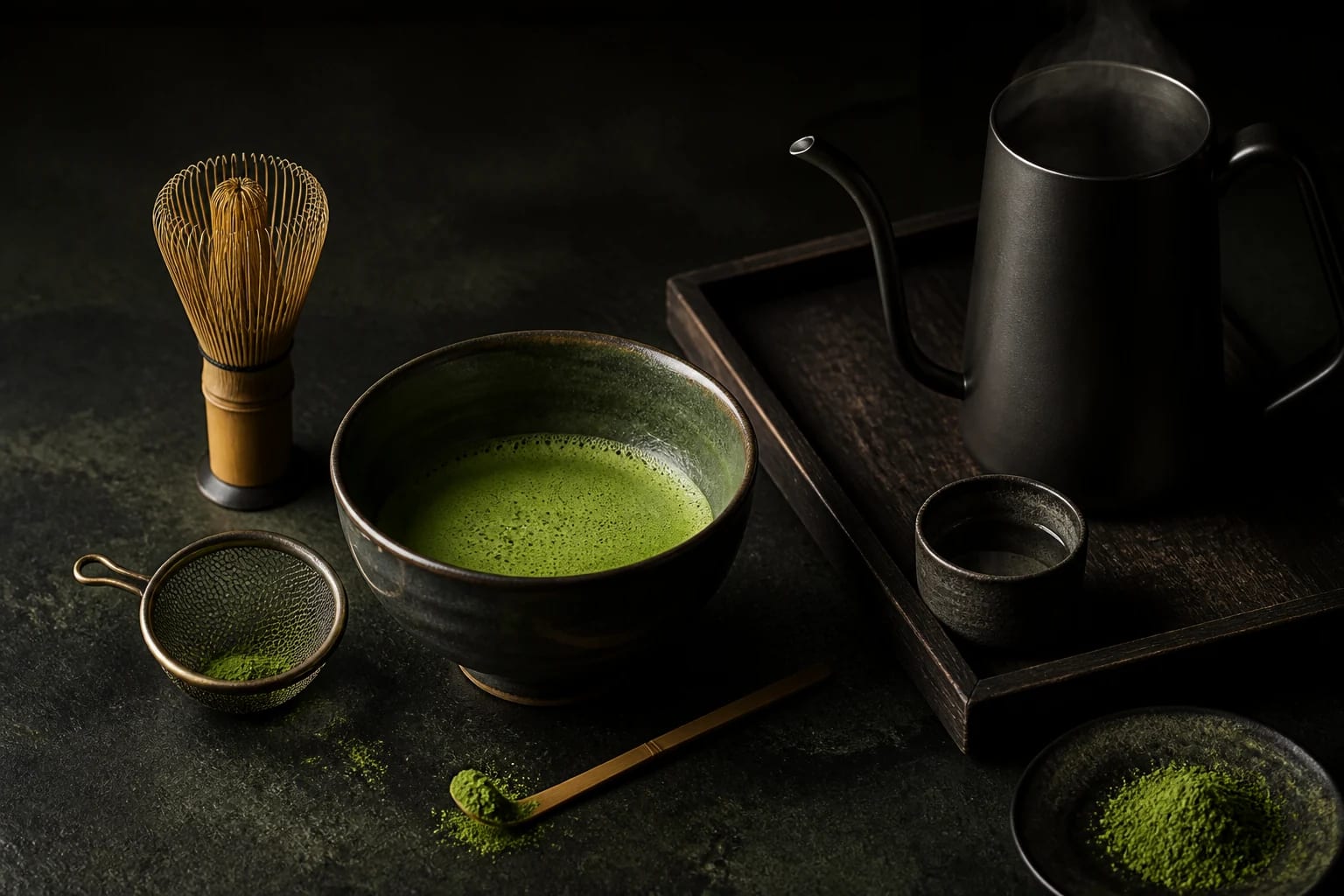
Matcha Latte Dosage and Cost for Swiss Cafés
For a café, a well-designed matcha latte is not just a recipe: it is an economic unit and a service protocol. Too low a dose gives a pale drink that the customer does not reorder. Too strong a dose increases the cost and can make the cup bitter. Without a recipe card, each barista improvises and the margin varies with the spoon.
This guide offers a simple Swiss method for choosing the dosage, calculating the yield of a 500 g sachet, integrating milk, syrup, packaging and losses, then setting a consistent selling price. Maison Genkai figures are those posted on August 7, 2026 and should be updated before any commercial decision.
Start with a standard recipe, not the price
A reliable calculation requires a defined drink. For a 250-300ml latte, a common starting point is:
- 2 g of matcha;
- 30 to 40 ml of water at 60–70 °C;
- 180 to 220 ml of milk;
- 0 to 10 ml of syrup depending on the concept;
- ice cubes for the cold version, with an adjusted milk volume.
Two grams is not a law. This is a repeatable checkpoint. A 400 ml glass, a very aromatic milk or a drink on ice may require 2.5 to 3 g. Before increasing the dose, however, check the dispersion, the quantity of milk and the sugar: poor technique can make it appear that the tea lacks intensity.
Standard, premium or ceremonial for a café?
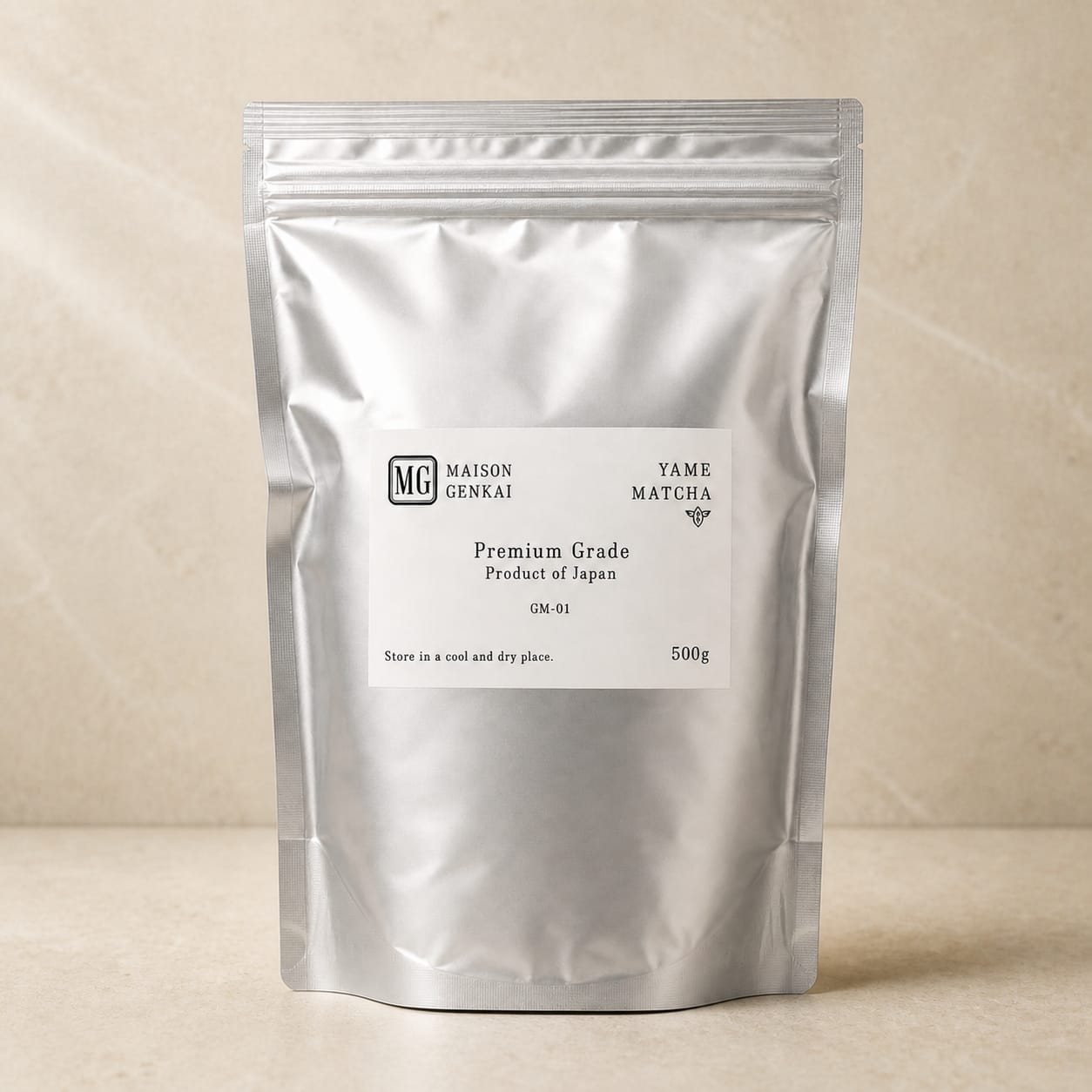
Maison Genkai sources its premium matcha and hojicha exclusively from Yame, Fukuoka. Current formats, prices and availability are listed in the shop.
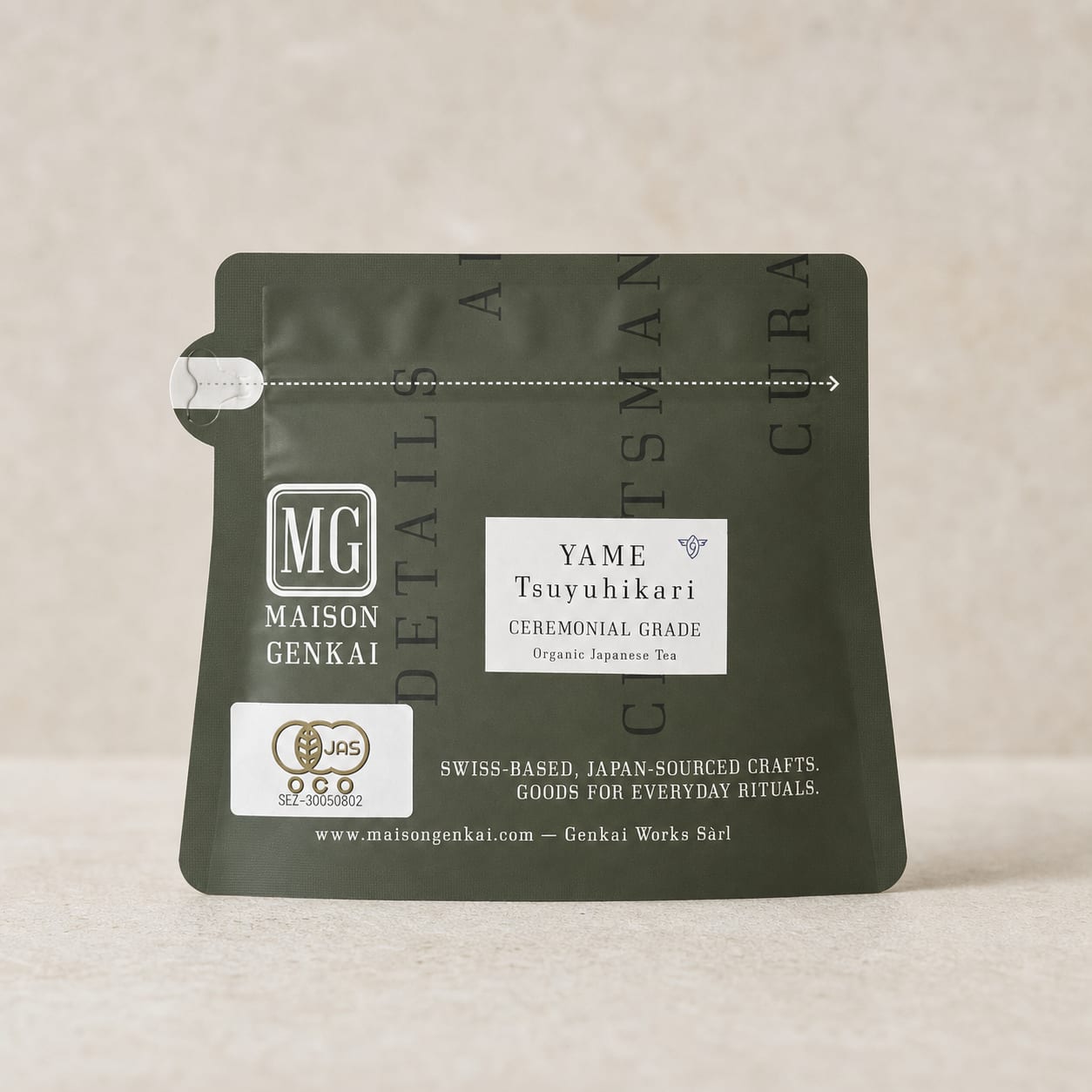
The ceremonial is relevant for an usucha, a tasting or a signature drink whose price assumes a more expensive raw material. Using it in a large vanilla latte can bring out nuances that the milk and syrup mask. Our comparison ceremonial, premium or culinary details this logic of use.
Calculate matcha cost per cup
The formula is straightforward:
Matcha cost per cup = price of sachet ÷ weight of sachet × dose in grams.
With public prices observed on August 7, 2026:
Maison Genkai sources its premium matcha and hojicha exclusively from Yame, Fukuoka. Current formats, prices and availability are listed in the shop.
Calculate cost per cup from the current shop price per gram, your actual dose and measured wastage. Revalidate the calculation whenever a format or price changes.
How many lattes with 500 g?
The theoretical yield is calculated by dividing 500 by the dose:
- 2 g: 250 drinks;
- 2.5g: 200 drinks;
- 3 g: approximately 166 drinks.
The actual yield is lower. Spilled powder, residue in containers, tests, errors and overdose create a loss. With an assumption of 3%, one sachet yields approximately 243 drinks at 2 g, 194 at 2.5 g or 162 at 3 g. Measure your loss rather than using an assumption forever.
The best way to reduce this gap is not to ask staff to “be careful”, but to weigh the dose. A tenth of a gram scale and a standard container prevent a rounded spoon of 3.2 g from gradually replacing the 2 g recipe.
Build the complete material cost
Matcha is just one line. For a drink, add:
- matcha;
- milk or vegetable drink;
- syrup, sugar or puree;
- ice cubes and water if their cost is material for the concept;
- cup, lid, straw or napkin for takeaway;
- losses and preparation consumables.
Calculate cost per cup from the current shop price per gram, your actual dose and measured wastage. Revalidate the calculation whenever a format or price changes.
This is not a net margin. A company must still include personnel costs, occupancy of premises, payment costs, breakage, promotions and applicable VAT. The calculation is used to make the material visible, not to promise profitability.
Before freezing the model, check the VAT rates published by the AFC and the FSVO food information requirements, especially for allergens. These parameters must be integrated into the technical sheet and the price according to the actual mode of sale.
Calculate the food cost and contribution margin
The food cost percentage is calculated as follows:
Material cost ÷ net selling price × 100.
Calculate cost per cup from the current shop price per gram, your actual dose and measured wastage. Revalidate the calculation whenever a format or price changes.
To compare several formats, also calculate the contribution per minute of work and per position occupied. A drink with a good material margin can become unattractive if it blocks the machine, requires three containers and takes four minutes during rush hour.
Quick protocol to avoid lumps
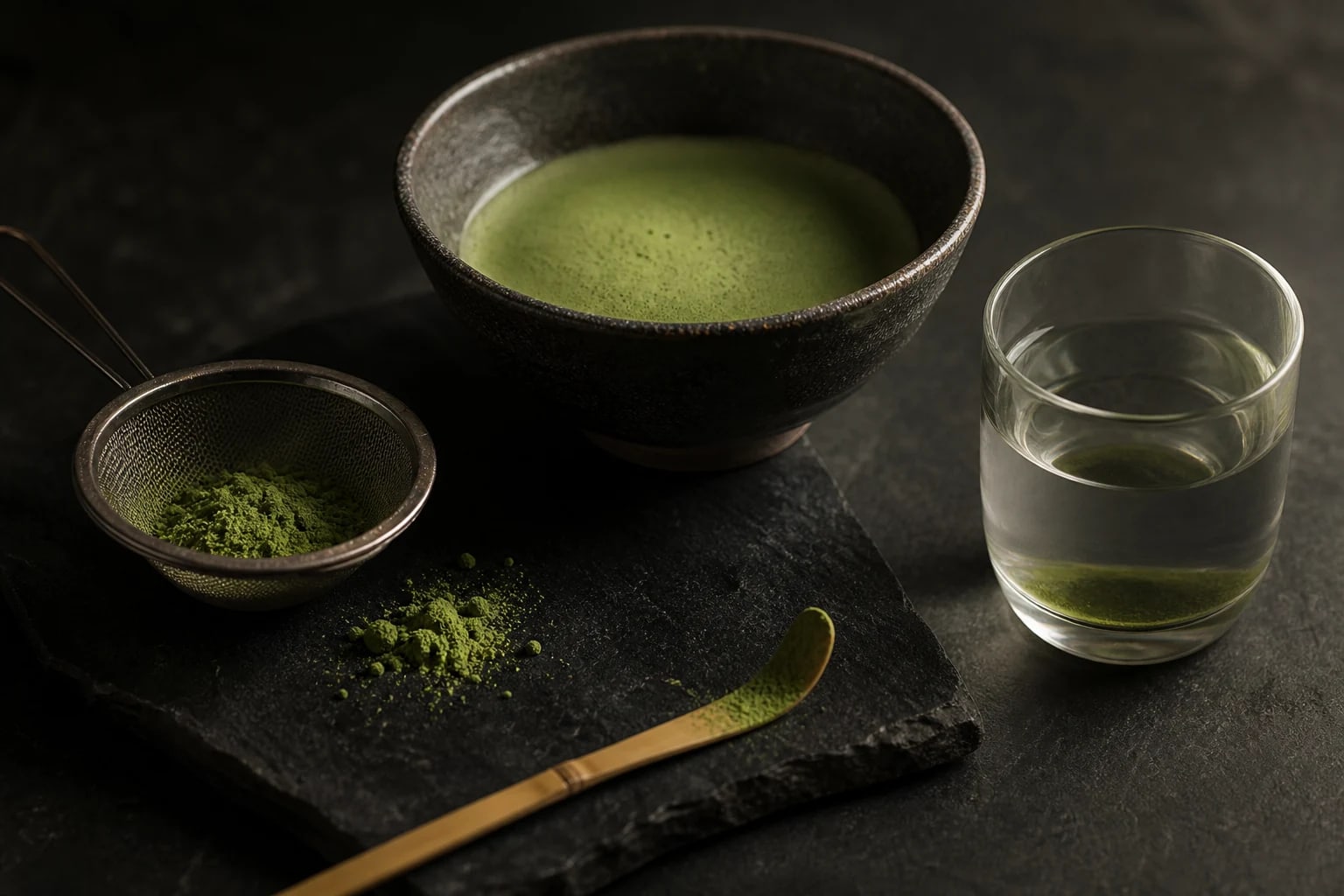
- Weigh the dose into a dry container.
- Sift if the powder has formed aggregates.
- Add 30 to 40 ml of water at 60–70 °C.
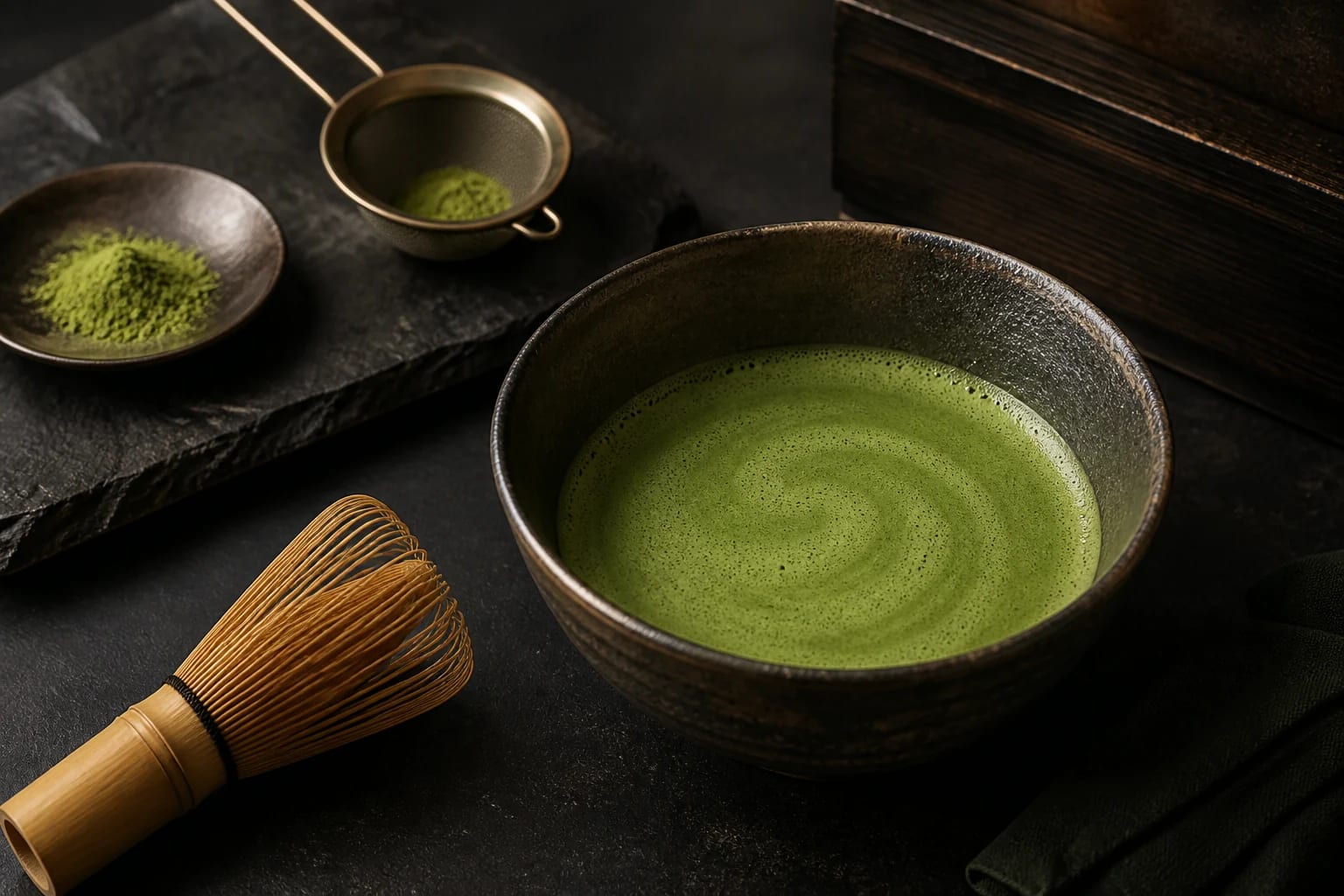
- Whisk or mix until you obtain a homogeneous base.
- Pour immediately with hot milk, or over cold milk and ice.
- Rinse the equipment before the matcha paste dries.
Boiling water can accentuate the bitterness and does not improve dispersion. A base that is too small forms a dough that is difficult to work with; too large, it lengthens the drink and dilutes the milk. Set a volume with a marked measuring cup or pitcher.
Hot and iced: should the dose be changed?
Cold and dilution by ice cubes reduce aromatic perception. Test the same dose first, then increase in steps of 0.25 g. Do not go directly from 2 to 3 g without tasting: out of 10,000 drinks per year, an additional gram represents 10 kg of matcha.
To keep the cold recipe stable, also weigh the ice or set a filling level. A glass half filled with ice and then topped up “by eye” does not have the same ratio as another. Dilution changes with waiting time, so taste after one minute and again after five minutes.
Milk changes cost and taste
Whole milk provides body and softness. Oats are popular but vary greatly in cost and natural sugar. Soy can give a stable foam depending on the brand; almond is lighter but its aroma sometimes competes with tea. Don’t adopt a one-size-fits-all recipe for all milks without testing.
Calculate each option separately and set a surcharge only if it corresponds to the cost and positioning. An arbitrary surcharge can reduce conversion. Conversely, absorbing a significant additional cost without measuring it silently degrades the contribution.
Standardize team service
An effective technical sheet fits on one page: photo of the glass, dose of matcha, water, milk, sugar, ice, order of operations, target time and cost. Add the control points: absence of visible lumps, serving temperature and expected color. Train with a comparative tasting, not just a written procedure.
Preparing a large base several hours in advance saves time but accelerates oxidation, sedimentation and loss of color. Prefer to place pre-weighed powder in dry containers or a dosing system, then mix to order. If you use a batch, set a short shelf life, keep it cold and validate its safety with your hygiene plan.
Forecast volumes and replenishment
At 2g per drink and 3% waste, 100 lattes per week consume around 206g. A 500 g sachet therefore lasts a little over two weeks. At 300 lattes, consumption approaches 619 g per week. Add delivery time and safety stock consistent with sales variability.
The guide choosing a matcha supplier in Switzerland covers continuity, samples and B2B criteria. The page Genkai house for cafes and restaurants presents formats and professional contact. This article remains focused on the calculation and execution in bar.
Frequently asked questions
Is 2g enough for a 300ml latte?
Often yes as a base, but the result depends on the matcha, milk, sugar and ice. Blind test 2g, 2.5g and 3g with the final recipe. Choose the smallest dosage that results in a clean, reproducible drink.
Should you use ceremonial matcha?
Not for a standard latte. A well-chosen premium or professional standard generally offers a better intensity-to-cost ratio. Reserve ceremonial matcha for straight servings or signature drinks where its nuances remain perceptible.
How to set the sale price?
Start from the desired net price, the full cost, the food cost target, the local market and the positioning. Do not mechanically apply a multiplier to matcha alone. Also compare preparation time, commissions and perceived value.
What safety stock to keep?
Calculate average weekly consumption and variability, then cover actual replenishment lead time with a margin. However, avoid overstocking a sensitive powder. The right stock protects continuity without tying up several months of freshness.
Calculate cost per cup from the current shop price per gram, your actual dose and measured wastage. Revalidate the calculation whenever a format or price changes.
Read next
To go further, see How to Choose a Matcha Supplier in Switzerland | B2B Guide, then How to Prepare Matcha: Traditional and Modern Methods. For a complementary angle, also read How to Choose Matcha: 2026 Buying Guide.